

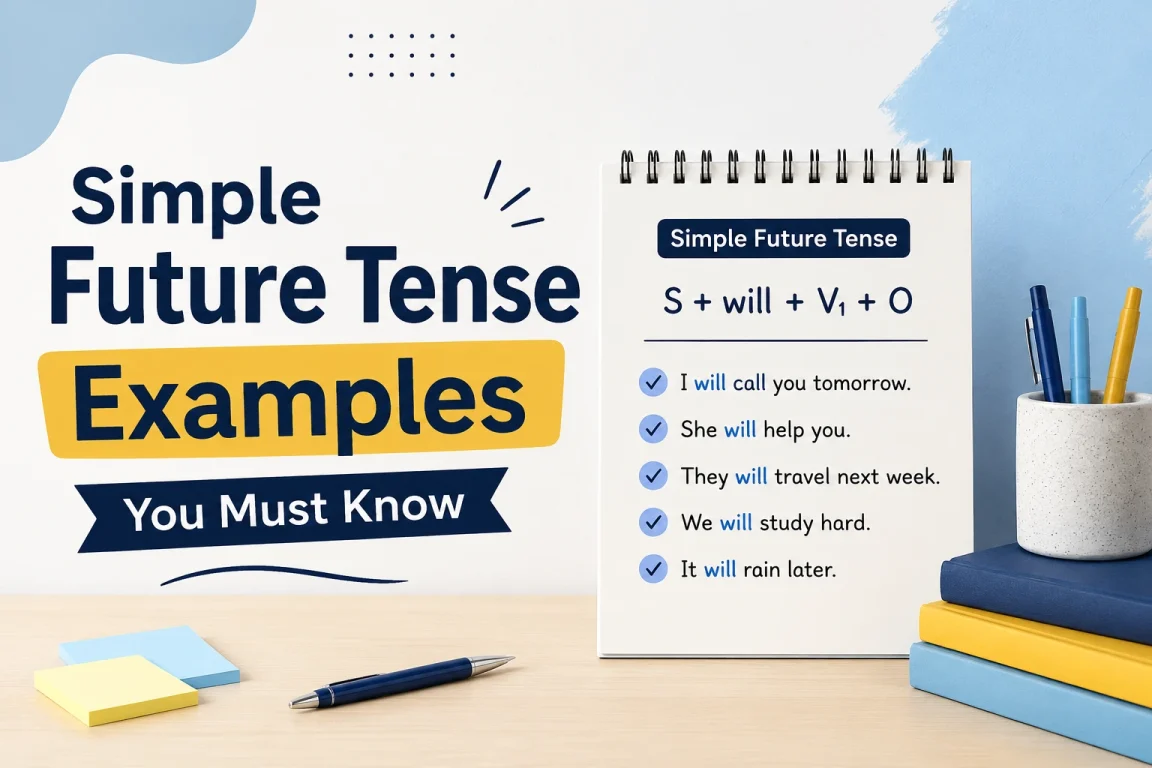
Learning the simple future tense becomes much easier when you focus on real examples instead of long rules.
In this guide, you will discover clear and practical simple future tense examples you can use in daily English.
From basic sentences to real-life situations, everything is designed to help you understand and remember quickly.
10 Examples of Simple Future Tense
Here are 10 easy examples of the simple future tense in English. We use the simple future tense to talk about actions, plans, or events that will happen in the future.
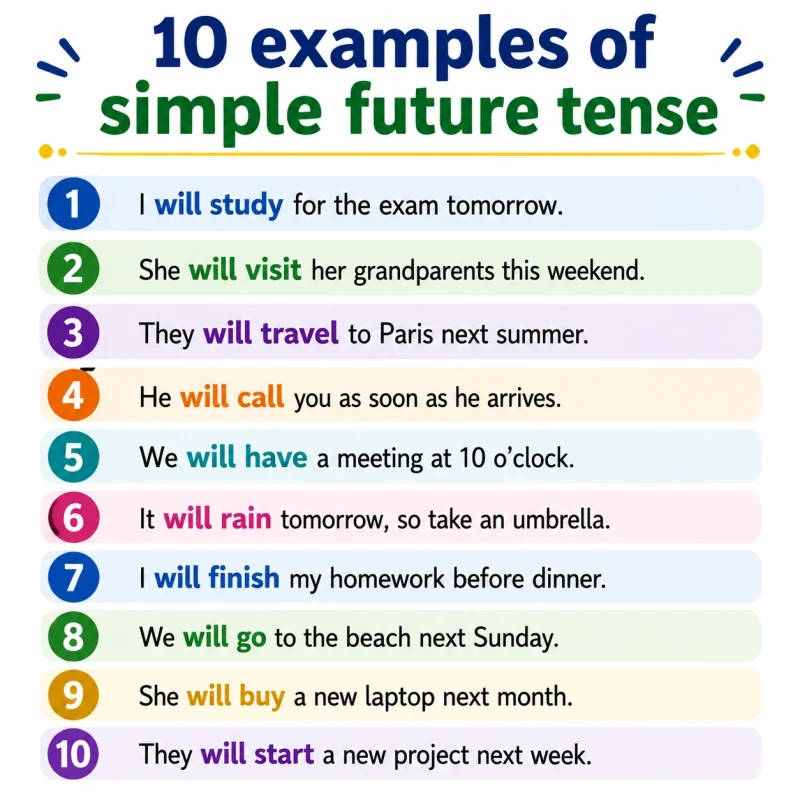
- I will call you tomorrow.
- She will study English tonight.
- They will visit their grandparents next weekend.
- We will watch a movie after dinner.
- He will start a new job next month.
- The teacher will give us homework today.
- My friends will travel to Spain next summer.
- It will rain later this evening.
- You will learn the simple future tense quickly.
- The children will play in the park after school.
These simple future tense examples show how we use “will + base verb” to talk about future actions and predictions. Using short and clear sentences is one of the best ways to improve your English grammar and speaking skills.
Simple Future Tense Examples Sentences About Daily Life
Learning grammar becomes easier when you practice with real-life situations. The following simple future tense examples sentences will help you understand how native speakers talk about future plans, daily activities, and upcoming events.
Morning Routine Examples
- I will wake up at 7 a.m. tomorrow.
- She will make coffee before work.
- We will eat breakfast together in the morning.
- He will take a shower after his workout.
- They will leave the house early tomorrow.
- My brother will drive me to school.
- I will check my emails after breakfast.
- The kids will get ready for school quickly.
- My father will read the news before work.
- We will catch the bus at 8 o’clock.
Family and Friends Examples
- I will visit my grandmother this weekend.
- My friends will come to my birthday party.
- She will help her sister with homework.
- We will spend time together tonight.
- They will watch a football game with their dad.
- My cousin will call me later.
- He will meet his friends after school.
- We will celebrate our anniversary tomorrow.
- My parents will travel next month.
- I will invite my neighbors to dinner.
Shopping and Food Examples
- I will buy some vegetables after work.
- She will cook pasta for dinner tonight.
- We will order pizza this evening.
- They will go grocery shopping tomorrow.
- He will make a chocolate cake for the party.
- My mother will prepare lunch soon.
- I will drink tea after dinner.
- The restaurant will open at noon.
- We will try a new café this weekend.
- She will not eat fast food tonight.
These examples show how the simple future tense is commonly used in everyday English conversations. Practicing daily life sentences can help you speak more naturally and confidently about future actions and plans.
Simple Future Tense Examples for School and Work
The simple future tense is very common in schools, workplaces, and professional conversations. These examples will help you learn how to talk about future activities, responsibilities, and plans in academic and work environments.
Classroom Examples
- The teacher will explain the lesson tomorrow.
- Students will take the test next Monday.
- I will finish my homework tonight.
- We will practice English in class today.
- She will answer the teacher’s question.
- They will read a new story next week.
- The school will organize a science competition soon.
- He will bring his notebook to class tomorrow.
- Our classmates will work on the project together.
- The teacher will check our assignments after class.
Office and Business Examples
- I will send the report this afternoon.
- She will attend the meeting tomorrow morning.
- We will discuss the new project later today.
- The manager will call the client soon.
- They will open a new office next year.
- He will reply to your email tomorrow.
- Our team will finish the task on time.
- The company will hire new employees next month.
- I will prepare the presentation before the meeting.
- The workers will complete the project next week.
Study Plans Examples
- I will study English for two hours tonight.
- She will review her notes before the exam.
- We will practice grammar after school.
- They will learn new vocabulary tomorrow.
- He will join an online English course next month.
- I will read an English book this weekend.
- My friend will help me with math homework.
- We will prepare for the final exam together.
- She will improve her speaking skills with daily practice.
- I will watch educational videos to improve my English.
These simple future tense examples for school and work can help English learners communicate clearly about future tasks, goals, and responsibilities in everyday academic and professional situations.
Simple Future Tense Examples About Travel and Future Plans
We often use the simple future tense to talk about travel, personal plans, dreams, and future goals. These examples will help you learn how to speak naturally about upcoming activities and long-term plans in English.
Vacation Sentences
- We will travel to Italy next summer.
- I will book the hotel tomorrow.
- She will visit her cousins in Canada next month.
- They will stay near the beach during their vacation.
- He will take many photos during the trip.
- My family will fly to Dubai next week.
- We will explore new places on our holiday.
- I will pack my suitcase tonight.
- The tourists will visit the museum tomorrow morning.
- She will enjoy her vacation with her friends.
Weekend Plans
- I will clean my room this weekend.
- We will watch a movie on Saturday night.
- My friends will come over for dinner.
- She will go shopping with her sister tomorrow.
- They will play football in the park on Sunday.
- He will relax at home after a busy week.
- I will visit my grandparents this weekend.
- We will try a new restaurant tomorrow night.
- My brother will help me with my project.
- The children will spend the weekend with their cousins.
Dreams and Goals
- I will become a doctor in the future.
- She will start her own business one day.
- We will build a successful career together.
- He will learn three foreign languages.
- They will travel around the world someday.
- I will improve my English speaking skills this year.
- My sister will graduate from university next year.
- We will achieve our goals with hard work.
- She will write her first book in the future.
- I will save money to buy a new house.
These simple future tense examples about travel and future plans show how English speakers talk about upcoming events, ambitions, and personal goals in daily conversations.
Simple Future Tense Negative Sentence Examples
In negative sentences, we use “will not” or the short form “won’t” to talk about actions that will not happen in the future. These examples will help you understand how to make negative sentences correctly in the simple future tense.
- I will not go to the party tonight.
- She won’t attend the meeting tomorrow.
- They will not travel next weekend.
- We won’t watch the movie this evening.
- He will not finish the project today.
- My friends won’t come to school tomorrow.
- The restaurant will not open early on Sunday.
- I won’t forget your birthday.
- She will not buy a new phone this year.
- We won’t stay at the hotel for long.
- The teacher will not give homework today.
- They won’t play football because of the rain.
- He will not answer the email tonight.
- I won’t wake up early tomorrow.
- My parents will not travel during the winter.
- She won’t cook dinner this evening.
- We will not spend too much money on vacation.
- The students won’t take the exam this week.
- He will not join us for lunch tomorrow.
- I won’t miss the English class again.
These simple future tense negative sentence examples show how English speakers use will not and won’t in everyday conversations. Practicing negative forms can help you speak and write more naturally in English.
Simple Future Tense Question Examples
We use the simple future tense in questions to ask about future plans, predictions, decisions, or actions. In most questions, we start with “will” followed by the subject and the base form of the verb.
Questions Starting With “Will You…?”
- Will you call me later?
- Will you help me with my homework?
- Will you attend the meeting tomorrow?
- Will you travel this summer?
- Will you join us for dinner tonight?
- Will you buy a new laptop soon?
- Will you study English tomorrow?
- Will you watch the game tonight?
- Will you visit your grandparents this weekend?
- Will you finish the project on time?
Questions Starting With “Will They…?”
- Will they come to the party tonight?
- Will they move to a new house next year?
- Will they participate in the competition?
- Will they arrive before noon?
- Will they travel together next month?
- Will they open a new store in the city?
- Will they complete the work today?
- Will they study for the exam tonight?
- Will they invite us to the wedding?
- Will they play football after school?
More Simple Future Tense Question Examples
- Will she cook dinner tonight?
- Will he start a new job soon?
- Will we have enough time to finish?
- Will your parents visit you next month?
- Will the weather improve tomorrow?
- Will the teacher explain the lesson again?
- Will your friends join the trip?
- Will the company hire more workers next year?
- Will I see you tomorrow?
- Will the children sleep early tonight?
These simple future tense question examples can help you ask about future events and plans naturally in English conversations. Practicing questions with will is an excellent way to improve both your grammar and speaking confidence.
Simple Future Tense Examples With Answers
This section will help you practice the simple future tense in a more interactive way. Try to answer first, then check the correct answers below. These simple future tense examples with answers are designed to improve both your grammar accuracy and confidence.
Fill in the Blanks
Complete the sentences using will + base verb:
- I ___ (call) you tomorrow.
- She ___ (visit) her friend next week.
- They ___ (travel) to Spain next summer.
- We ___ (finish) the project soon.
- He ___ (buy) a new phone later.
Answers:
- will call
- will visit
- will travel
- will finish
- will buy
Multiple Choice Questions
Choose the correct answer:
- I ___ go to the party tonight.
a) will
b) go
c) going - She ___ help you tomorrow.
a) will
b) is
c) helping - They ___ arrive late.
a) will
b) are
c) have - We ___ watch a movie later.
a) will
b) do
c) did - He ___ study English next year.
a) will
b) was
c) is
Answers:
- a) will
- a) will
- a) will
- a) will
- a) will
Correct the Mistakes
Fix the incorrect sentences:
- I will to go to school tomorrow.
- She will goes to the market later.
- They will played football next week.
- He will eating dinner tonight.
- We will goes to the beach tomorrow.
Correct Answers:
- I will go to school tomorrow.
- She will go to the market later.
- They will play football next week.
- He will eat dinner tonight.
- We will go to the beach tomorrow.
These simple future tense examples with answers are a great way to practice and test your understanding. Regular practice with exercises like these will help you use the simple future tense correctly and naturally in real-life English conversations.
Common Mistakes in Simple Future Tense Examples
Many learners of English understand the simple future tense, but still make small structural mistakes. These errors are very common, and fixing them will instantly improve both writing and speaking accuracy.
Using “will” with -ing forms
One of the most frequent mistakes is adding an -ing form after will.
Incorrect
I will going to school tomorrow
She will cooking dinner tonight
Correct
I will go to school tomorrow
She will cook dinner tonight
After will, always use the base form of the verb, not the ing form.
Using “will” with past tense verbs
Some learners incorrectly combine will with past verbs.
Incorrect
They will went to the park
He will finished the work
Correct
They will go to the park
He will finish the work
Will must always be followed by the base form, never past tense.
Adding unnecessary third person s
Another common error is adding s to the verb after will.
Incorrect
She will goes to school
He will eats breakfast
Correct
She will go to school
He will eat breakfast
The verb never changes after will, even with he, she, or it.
Mixing will and going to in the same structure
Learners sometimes combine two future forms incorrectly.
Incorrect
I will going to travel tomorrow
Correct
I will travel tomorrow
I am going to travel tomorrow
Choose one structure only, do not mix them.
Incorrect negative forms
Mistakes often happen when forming negative sentences.
Incorrect
She will not to come
They will not goes to school
Correct
She will not come
They will not go to school
After will not, the verb stays in its base form.
Incorrect question structure
In questions, learners sometimes add extra words or incorrect verb forms.
Incorrect
Will you to help me
Will she goes home
Correct
Will you help me
Will she go home
The correct order is will followed directly by the subject and the base verb.
Final Tip
The key rule for the simple future tense is very simple. Always use will followed by the base form of the verb. If you remember this rule, most of these common mistakes will disappear quickly and your English will become more natural and accurate.
Mastering the simple future tense is all about consistent practice with real sentences.
These examples help you speak and write about the future with confidence and accuracy.
Keep practicing daily, and your English will become more natural and fluent over time.