


English for Hotel is a must-have skill for anyone working in the hotel industry or traveling internationally. From welcoming guests to handling reservations and daily requests, using the right English expressions helps create smooth communication and a professional guest experience.
This complete guide to English for Hotel focuses on practical hotel vocabulary and real conversations used in hotels every day. It will help you communicate clearly, confidently, and politely in real hotel situations.
ntroduction to English for Hotel Industry
English for the hotel industry is a core communication skill used in daily hotel operations. It is not limited to casual conversation, but is essential for handling reservations, explaining hotel policies, responding to guest requests, and solving problems in a clear and professional manner. Effective use of English helps ensure smooth communication between hotel staff and international guests.
In a hotel environment, staff members interact with guests at different stages of their stay, from arrival to departure. Clear English communication allows staff to provide accurate information, coordinate services between departments, and maintain a polite and welcoming tone at all times. This is especially important in busy or high-pressure situations where misunderstandings can affect the guest experience.
This section introduces how English is practically used in the hotel industry, focusing on real workplace needs rather than theory. It prepares you to understand hotel vocabulary, hotel conversations, and common hotel dialogues that will be covered in the following sections of this guide.
Essential Hotel Vocabulary in English
These are essential hotel vocabulary words commonly used by guests and hotel staff in daily hotel situations. Learning these terms helps you understand instructions, make requests, and communicate professionally in the hotel environment.
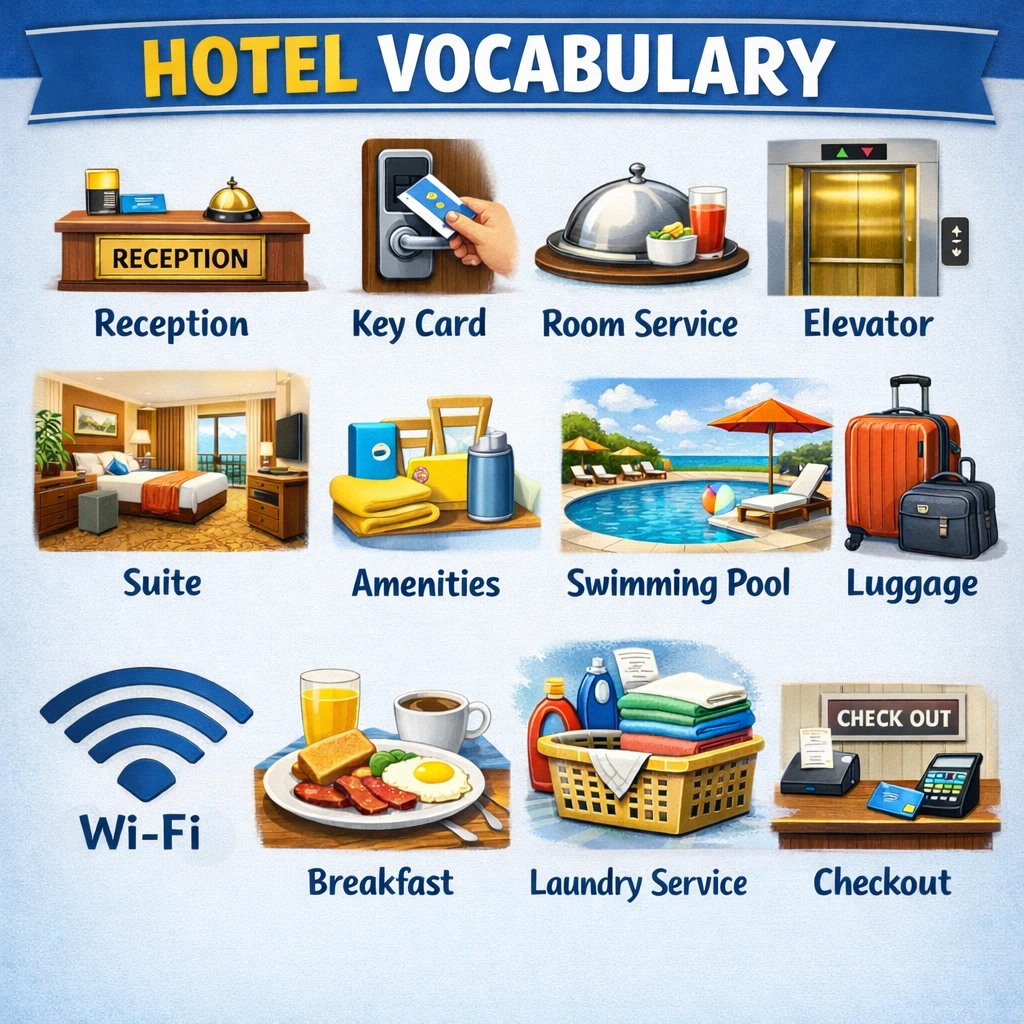
Hotel Staff Vocabulary
1. Reception
Meaning: The front desk area where guests check in and get assistance.
Example: Please go to the reception to collect your room key.
2. Receptionist
Meaning: A person who works at the reception desk.
Example: The receptionist helped us check in quickly.
3. Housekeeping
Meaning: The hotel department responsible for cleaning rooms.
Example: Housekeeping cleans the rooms every morning.
4. Concierge
Meaning: A staff member who helps guests with information and services.
Example: The concierge recommended a good restaurant nearby.
5. Bellboy / Porter
Meaning: A staff member who helps guests carry their luggage.
Example: The bellboy took our bags to the room.
Hotel Facilities Vocabulary
6. Lobby
Meaning: The main entrance area of a hotel.
Example: Guests are waiting in the lobby.
7. Elevator
Meaning: A machine that takes guests to different floors.
Example: The elevator is located next to the reception.
8. Restaurant
Meaning: A place in the hotel where meals are served.
Example: Breakfast is served in the hotel restaurant.
9. Gym
Meaning: A place where guests can exercise.
Example: The gym opens at 6 a.m.
10. Parking
Meaning: An area where guests can park their cars.
Example: Free parking is available for hotel guests.
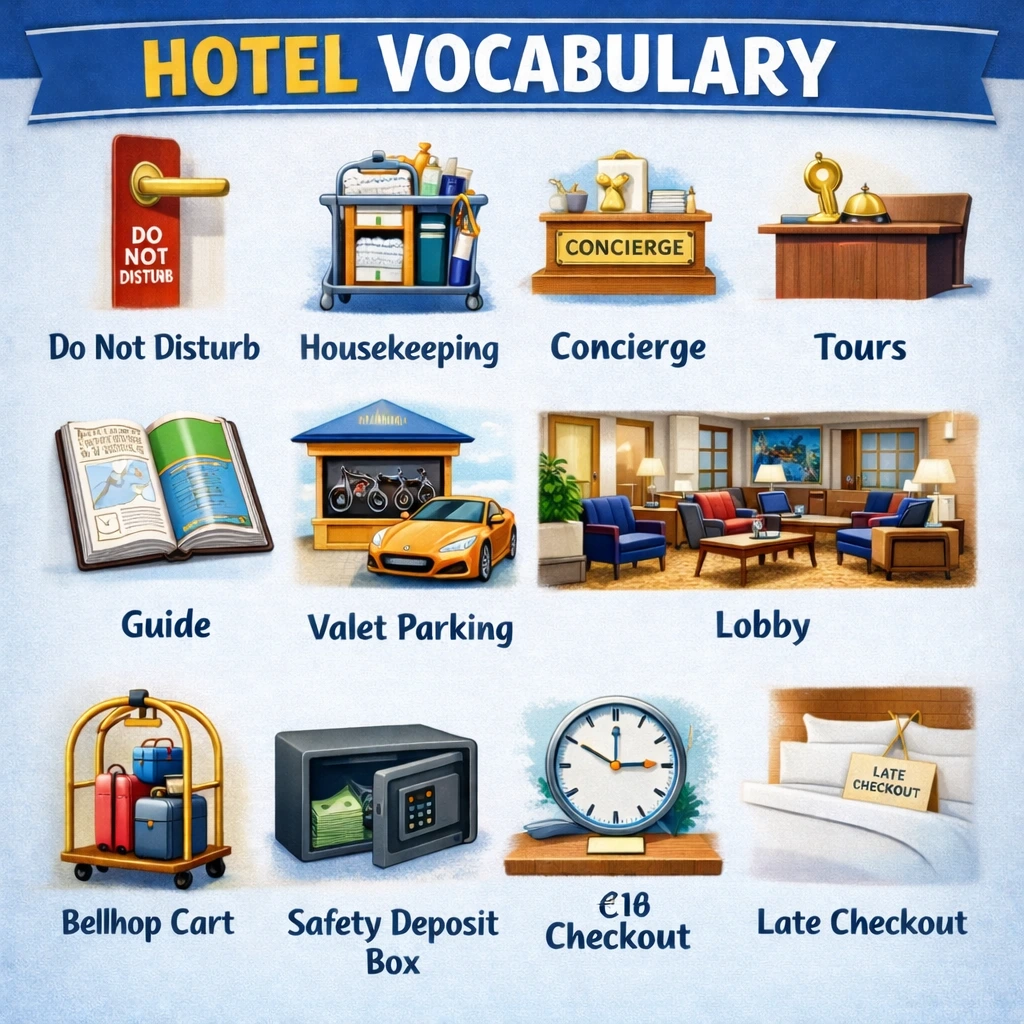
Hotel Services Vocabulary
11. Check-in
Meaning: The process of registering when you arrive at the hotel.
Example: Check-in starts at 2 p.m.
12. Check-out
Meaning: The process of leaving the hotel and paying the bill.
Example: Check-out is before 12 p.m.
13. Room Service
Meaning: Food or drinks delivered to a guest’s room.
Example: We ordered breakfast through room service.
14. Wake-up Call
Meaning: A phone call from the hotel to wake a guest up.
Example: I requested a wake-up call at 7 a.m.
15. Reservation
Meaning: An arrangement to book a room in advance.
Example: I made a reservation online.
For a deeper understanding of hotel terms, you can also study our guide on 120 hotel vocabulary explained with clear meanings and examples used in real hotel situations.
These hotel vocabulary words are the building blocks of English for hotel communication. They appear frequently in hotel conversations, reservation discussions, and check-in situations.
Hotel Conversation in English for Daily Situations
Hotel conversation in English is used every day between guests and hotel staff to handle common situations during a hotel stay. These conversations focus on being clear, polite, and professional. Learning typical hotel conversations helps you feel more confident and respond naturally in real hotel environments.
Below are common daily hotel situations with simple English conversations that are frequently used in hotels.
Asking for Help at the Reception
Guest: Excuse me, I need some help.
Staff: Of course. How can I assist you?
Guest: I can’t find my room.
Staff: No problem. I’ll show you the way.
Requesting Hotel Services
Guest: Hello, could I get extra towels, please?
Staff: Certainly. I’ll send them to your room right away.
Guest: Thank you very much.
Staff: You’re welcome.
Asking About Hotel Facilities
Guest: Does the hotel have a gym?
Staff: Yes, the gym is on the second floor.
Guest: What time does it open?
Staff: It opens at 6 a.m.
Reporting a Problem
Guest: Hello, there is a problem with my room.
Staff: I’m sorry to hear that. What seems to be the issue?
Guest: The air conditioning isn’t working.
Staff: I’ll send someone to fix it immediately.
Asking for Information
Guest: Excuse me, is there a restaurant nearby?
Staff: Yes, there is one across the street.
Guest: Thank you for your help.
Staff: My pleasure.
To improve your speaking skills in real situations, explore our Hotel Conversation in English with real dialogues for travelers, which covers common hotel interactions step by step.
These hotel conversations in English reflect real daily situations that guests experience during their stay. By practicing these short dialogues, you can improve your speaking skills, understand hotel dialogue more easily, and communicate confidently with hotel staff in everyday hotel situations.
Final Tips to Master English for Hotel Communication
Mastering English for hotel communication requires consistent practice and a clear focus on real hotel situations. Instead of learning isolated words, concentrate on complete phrases commonly used in hotels, such as welcoming guests, confirming details, and responding politely to requests. This approach helps you sound more natural and professional in daily interactions.
Practice speaking English in realistic hotel scenarios as often as possible. Role-playing situations like check-in, room reservations, service requests, and check-out will build confidence and improve fluency. Repeating these conversations aloud also helps with pronunciation and listening comprehension.
Listening is just as important as speaking. Pay attention to how English is used in hotel dialogues, whether through training videos, recorded conversations, or real interactions at work. Notice polite expressions, tone, and sentence structure, and try to use them in your own speech.
Finally, review hotel vocabulary and conversations regularly. Consistent repetition helps you remember key expressions and respond quickly in real situations. By combining vocabulary study with practical hotel conversations, you can communicate clearly, avoid misunderstandings, and deliver a better experience for every guest.
Learning English for Hotel is a powerful step toward better communication and higher service quality in the hospitality industry. By understanding hotel vocabulary and practicing real hotel conversations, you can respond to guests professionally and handle daily situations with confidence.
Whether you are preparing for a hotel job or traveling abroad, improving your English for Hotel will help you avoid misunderstandings, build trust with guests, and deliver a better hotel experience. Keep practicing regularly, and use real examples to make your English more natural and effective.