
Asking questions is a key part of communication in English. Simple present tense interrogative sentences are used every day to ask about habits, routines, and general facts.
In this guide, you will learn how to form questions using do and does, understand the correct structure, and see many simple present tense interrogative sentences examples. You will also learn how to use Wh-questions and give short answers naturally.
By the end of this article, you will be able to form clear and correct questions in everyday English.
What Are Interrogative Sentences in the Simple Present?
Interrogative sentences in the simple present are questions we use to ask about daily routines, habits, and general facts. They help us get information or confirm something.
Examples
- Do you like coffee?
- Does she work here?
- Do they play football every day?
These are called simple present tense interrogative sentences because they follow a specific question structure using do and does.
If you want to see how these sentences look in real-life situations, you can check Simple Present Tense Examples for Everyday English, which includes many practical examples of the present simple.
Structure of Simple Present Interrogative Sentences
The structure is simple and easy to remember:
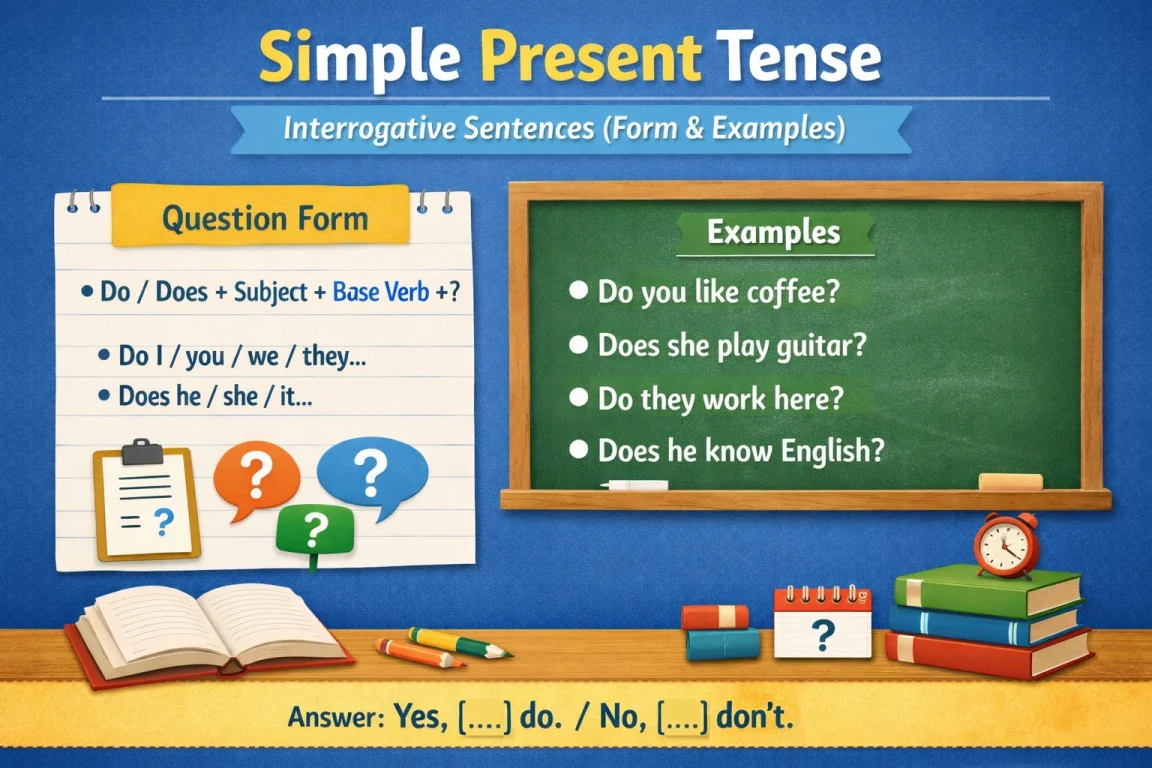
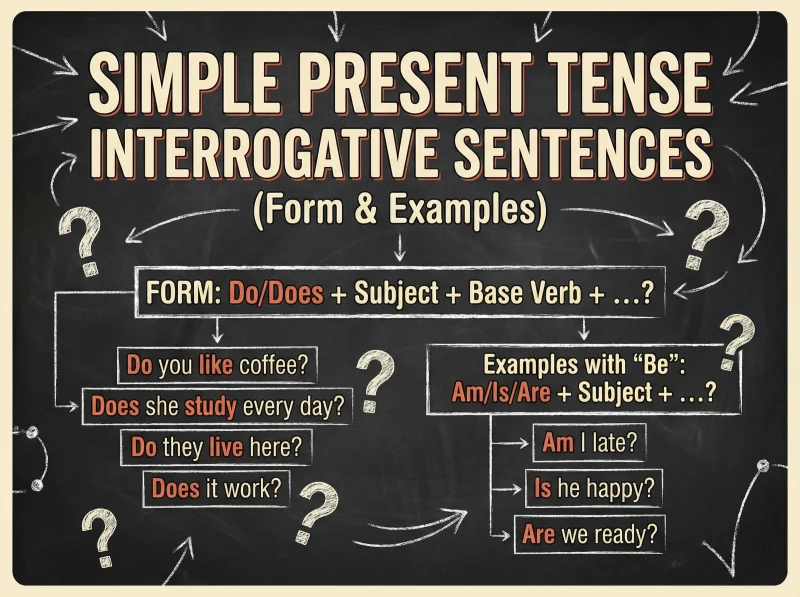
Do / Does + Subject + Base Verb + ?
Table: Question Structure
| Subject | Auxiliary | Example |
|---|---|---|
| I / You / We / They | Do | Do you like tea? |
| He / She / It | Does | Does she work here? |
Important Rule
After do or does, the verb stays in the base form:
✔ Does she like coffee
✘ Does she likes coffee
To practice forming these questions, you can try Present Simple Questions – Exercises with Answers, where you will find interactive exercises and answer keys.
Simple Present Tense Interrogative Sentences Examples
Below are simple present tense interrogative sentences examples. These questions use Do and Does to ask about daily routines, habits, and general facts.
Examples with Do (I, You, We, They)
- Do you like coffee?
- Do they play football after school?
- Do we have a meeting today?
- Do you speak English?
- Do they live near here?
- Do we study grammar every day?
- Do you work on weekends?
- Do they watch TV at night?
- Do you read books often?
- Do we start the class at 9 a.m.?
- Do they eat breakfast early?
- Do you need help with your homework?
- Do we go to school by bus?
- Do they understand the lesson?
- Do you like learning English?
Examples with Does (He, She, It)
- Does he like tea?
- Does she work in an office?
- Does it rain a lot here?
- Does he play football every day?
- Does she read books at night?
- Does it open at 9 a.m.?
- Does he understand the question?
- Does she eat meat?
- Does it work properly?
- Does he drive to work?
- Does she watch TV every evening?
- Does it cost a lot of money?
- Does he go to the gym?
- Does she speak Spanish?
- Does it look good?
Important Note
In all these simple present interrogative sentences, the verb stays in the base form after do and does:
✔ Does she like coffee
✘ Does she likes coffee
If you want to learn how to answer these questions correctly, you can check Present Simple Questions, where you will find clear explanations of short answers and question forms.
Wh- Questions in the Simple Present
In addition to Yes/No questions, we also use Wh- questions to ask for specific information. These questions begin with words like what, where, when, why, and how.
Structure
Wh-word + do/does + subject + base verb + ?
Examples
- What do you eat for breakfast?
- Where do they live?
- When do you start work?
- Why do you study English?
- How do you go to school?
- What does she do after work?
- Where does he live?
- When does she start school?
- Why does he learn English?
- How does she travel to work?
These simple present tense interrogative sentences examples help learners ask about time, place, reason, and actions.
If you want to practice these question types, you can try Present Simple Questions – Exercises with Answers, which includes structured activities and answer keys.
Simple Present Interrogative Sentences with Short Answers
In English, many simple present interrogative sentences are answered using short answers instead of repeating the full sentence.
Examples
| Question | Short Answer |
|---|---|
| Do you like coffee? | Yes, I do. / No, I don’t. |
| Do they play football? | Yes, they do. / No, they don’t. |
| Does she work here? | Yes, she does. / No, she doesn’t. |
| Does he read books? | Yes, he does. / No, he doesn’t. |
| Do you study English? | Yes, I do. / No, I don’t. |
Conclusion
Mastering simple present tense interrogative sentences helps you ask questions confidently and communicate more effectively in English. By understanding the correct structure using do and does, and remembering to keep the main verb in the base form, you can avoid common mistakes and build accurate questions.
To improve your skills further, you can explore more examples in Simple Present Tense Examples for Everyday English.