
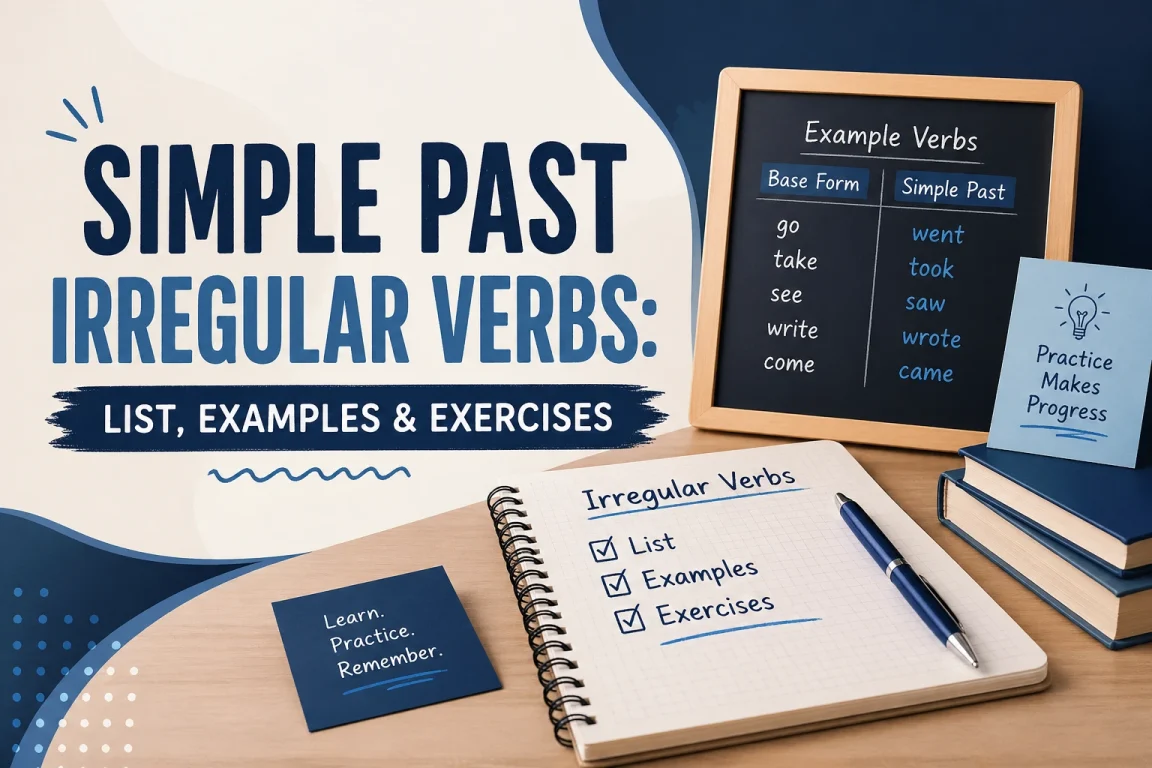
Struggling with simple past irregular verbs? You’re not alone. These verbs don’t follow normal rules, which makes them tricky for many English learners. In this guide, you’ll learn clear lists, real examples, and practical exercises to help you understand and use irregular verbs with confidence.
What Are Simple Past Irregular Verbs?
Simple past irregular verbs are verbs that do not follow the regular rule of adding -ed to form the past tense. Instead, they change completely or take unique forms that must be memorized.
For example:
- go → went
- see → saw
- eat → ate
- buy → bought
These verbs are very common in everyday English, which makes them essential for speaking and understanding real conversations.
If you want to see how these verbs are used in full sentences, you can check our guide on Simple Past Tense Examples for more context and practice.
Why Irregular Verbs Are Important in English
Irregular verbs are important because they appear frequently in daily communication, books, movies, and conversations.
1. They are very common in spoken English
Many of the most used verbs in English are irregular, such as go, have, take, see, and make.
2. They are essential for fluency
Using incorrect verb forms can make your English sound unnatural or confusing.
3. They help you understand real English faster
You will often hear irregular verbs in past tense without any clear pattern, so recognizing them improves listening skills.
Mastering irregular verbs is a key step toward speaking English more naturally and confidently.
Simple Past Irregular Verbs List
Building a strong simple past irregular verbs list is essential if you want to speak English fluently and understand everyday conversations.
Since these verbs do not follow a fixed rule, learning them through common groups and repetition is the most effective method.
Most Common Irregular Verbs You Must Know
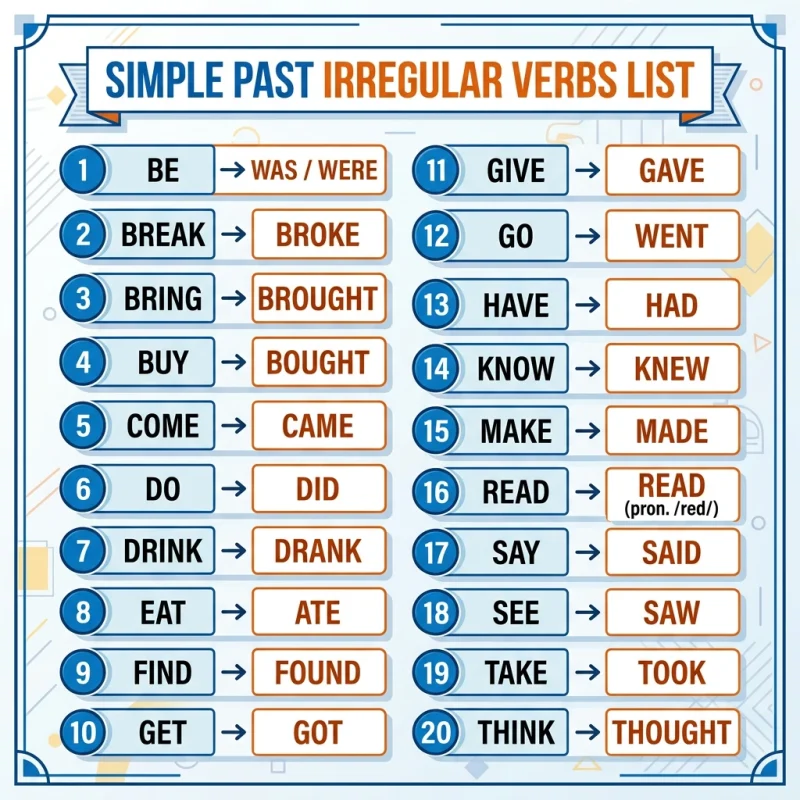
Here are some of the most important irregular verbs you should memorize first:
| Base Verb | Past Simple |
|---|---|
| go | went |
| come | came |
| see | saw |
| eat | ate |
| take | took |
| get | got |
| make | made |
| have | had |
| do | did |
| say | said |
| know | knew |
| think | thought |
| give | gave |
| find | found |
| bring | brought |
These verbs appear very often in daily conversations, so mastering them will significantly improve your understanding and speaking ability.
High-Frequency Verbs for Daily Use
These irregular verbs are especially common in real-life communication:
- I went to school yesterday.
- She saw a movie last night.
- They had a great time at the party.
- We made dinner together.
- He got a new job last month.
- I took the bus this morning.
- She gave me a gift.
- They came home late.
- We did our homework.
- He said hello to everyone.
Simple Past Irregular Verbs Examples
Learning through simple past irregular verbs examples is one of the fastest ways to understand how these verbs work in real communication.
Instead of memorizing rules, seeing them in context helps you remember them naturally and use them correctly.
Sentences Using Irregular Verbs
Here are clear examples of irregular verbs in the past simple tense:
- I went to the supermarket yesterday.
- She saw her friend at the station.
- They ate dinner at a new restaurant.
- We took a taxi to the airport.
- He wrote a long email last night.
- I bought a new jacket last week.
- She gave me some advice.
- They came home late.
- We did our homework together.
- He found his keys under the table.
These sentences show how irregular verbs change completely in the past simple form.
Real-Life Usage Examples
Irregular verbs are everywhere in daily English conversations:
- I didn’t know the answer in class yesterday.
- Did you see that movie last weekend?
- She went to work early this morning.
- They had a great time at the party.
- We made a mistake in the exercise.
- He got a new phone last month.
- I spoke to my teacher after class.
- She left the office at 5 PM.
- They brought food to the meeting.
- We met our friends downtown.
These real-life examples help you connect grammar with actual communication, making it easier to speak and understand English naturally.
Simple Past Irregular Verbs Exercises
Practicing simple past irregular verbs exercises is the best way to move from memorizing rules to actually using them correctly in real sentences.
These activities will help you recognize irregular verb forms quickly and use them with confidence.
Fill in the Blanks
Complete the sentences using the correct past simple form of the irregular verbs in brackets:
- I ______ (go) to school yesterday.
- She ______ (see) a beautiful bird in the garden.
- They ______ (eat) pizza last night.
- We ______ (take) a taxi to the airport.
- He ______ (write) a message to his friend.
- I ______ (buy) a new phone last week.
- She ______ (give) me a present.
- They ______ (come) home late.
- We ______ (find) a wallet on the street.
- He ______ (have) a great time at the party.
Choose the Correct Verb Form
Choose the correct past simple irregular verb form:
- I (go / went / gone) to the market yesterday.
- She (see / saw / seen) her teacher in town.
- They (eat / ate / eaten) breakfast early.
- We (take / took / taken) the bus to work.
- He (write / wrote / written) a letter last night.
- I (buy / bought / buys) a new book.
- She (give / gave / given) me some advice.
- They (come / came / coming) home late.
- We (find / found / finded) the keys.
- He (have / had / has) a meeting yesterday.
These exercises help reinforce irregular verb patterns and improve your accuracy in both writing and speaking English.
Tips to Memorize Irregular Verbs Faster
Learning simple past irregular verbs can feel difficult at first because there is no fixed rule.
However, with the right strategies, you can memorize them faster and use them naturally in speaking and writing.
Daily Practice Methods
1. Learn in small groups
Don’t try to memorize everything at once. Focus on 5–10 verbs daily.
Example: go → went, see → saw, take → took
2. Use verbs in real sentences
Create your own examples instead of only reading lists.
- I went to school yesterday.
- She saw a movie last night.
- They ate lunch at noon.
3. Repeat out loud every day
Speaking helps your brain remember faster than silent reading.
Say: go – went – gone, see – saw – seen
4. Use flashcards or quick reviews
Review old verbs before learning new ones to strengthen memory.
5. Practice with exercises regularly
Exercises help you apply what you learn. You can strengthen your skills with our guide on Simple Past Irregular Verbs Exercises for extra practice and testing.
Consistent daily practice is the fastest way to master irregular verbs and improve your fluency.
Mastering simple past irregular verbs takes practice, but it becomes much easier when you learn them step by step and use them in real sentences. Keep reviewing lists, practicing exercises, and applying what you learn in daily English to improve faster and speak more naturally.