
Travel vocabulary IELTS is an essential part of preparing for the Speaking and Writing sections of the exam. Knowing the right words and phrases helps you describe destinations, experiences, and holiday activities clearly and confidently. From discussing popular tourist attractions to explaining travel plans and cultural experiences, having a strong travel vocabulary makes your answers more natural and fluent.
This guide covers practical words, expressions, and phrases that every IELTS learner should know, along with examples and tips to use them effectively in real exam situations.
What Is Travel Vocabulary for IELTS?
Travel vocabulary for IELTS refers to the words and phrases related to travel, holidays, transportation, and tourism that are commonly used in the IELTS exam. These vocabulary items help you talk confidently about travel topics in both the Speaking and Writing sections.
In the IELTS test, travel is a very popular topic. You may be asked to describe:
- A memorable trip or holiday
- Your favorite destination
- Traveling abroad or in your country
- The advantages and disadvantages of tourism
Using the right IELTS travelling vocabulary shows the examiner that you can express ideas clearly and naturally.
Why Travel Vocabulary Is Important for IELTS
Learning travel vocabulary for IELTS helps you:
- Improve your Speaking score by sounding more fluent
- Write better answers in Writing Task 2
- Avoid repeating simple words like “good” or “nice”
- Show a strong range of vocabulary, which increases your band score
For a comprehensive list of travel-related words, phrases, and practice exercises, check out The Ultimate Travel Vocabulary Guide: 107 Words, Phrases & Practice Exercises, which is perfect for IELTS learners.
Travel Vocabulary vs Holiday Vocabulary IELTS
While travel vocabulary includes transport, destinations, and journeys, holiday vocabulary IELTS focuses more on:
- Vacations and breaks
- Leisure activities
- Hotels and accommodation
- Relaxation and tourism
Both types are essential and often appear together in IELTS questions.
Mastering travel-related vocabulary will help you speak and write with confidence in the IELTS exam.
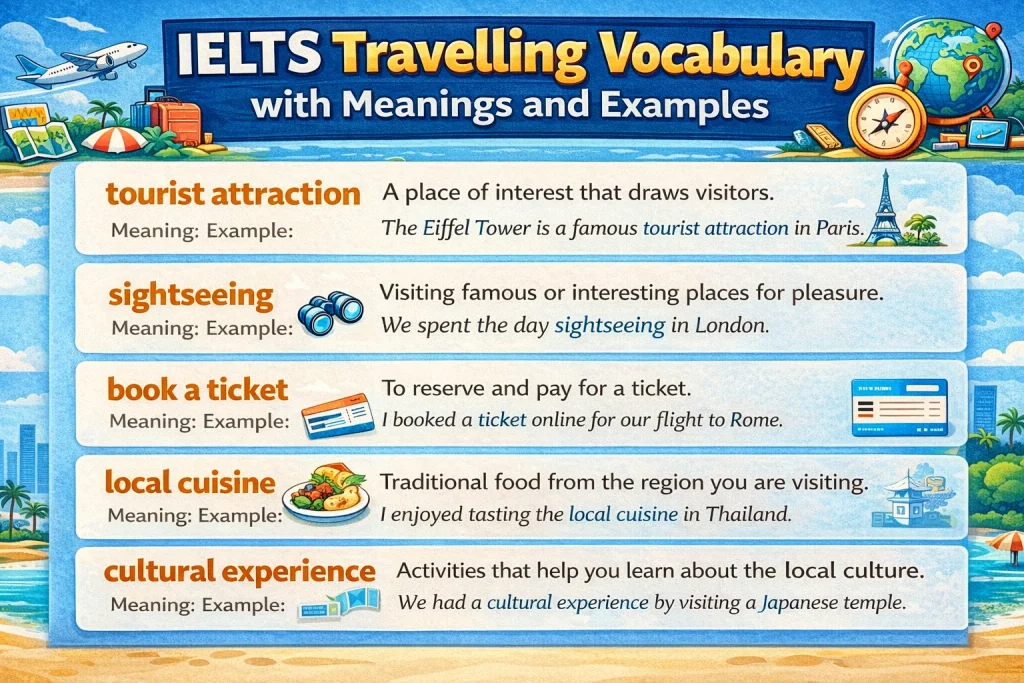
IELTS Travelling Vocabulary with Meanings and Examples
Using a wide range of IELTS travelling vocabulary helps you express ideas clearly and achieve a higher band score in the IELTS exam. Below is a carefully selected list of useful travel-related words with clear meanings and examples.
Transportation & Travel Basics
1. Destination
Meaning: The place you are going to
Example: Paris is a popular travel destination.
2. Journey
Meaning: The act of traveling from one place to another
Example: The journey took more than six hours.
3. Trip
Meaning: A short journey
Example: I went on a short trip last weekend.
4. Commute
Meaning: Travel regularly between home and work
Example: I commute to work by train every day.
5. Public transport
Meaning: Buses, trains, and metros used by the public
Example: Public transport is convenient in big cities.
Holidays & Tourism
6. Holiday
Meaning: Time spent traveling or relaxing
Example: We went on holiday to Italy.
7. Vacation
Meaning: A break from work or study
Example: I took a vacation during summer.
8. Tourism
Meaning: The business of travel for pleasure
Example: Tourism creates many job opportunities.
9. Tourist attraction
Meaning: A place people like to visit
Example: The museum is a major tourist attraction.
10. Sightseeing
Meaning: Visiting famous places
Example: We spent the day sightseeing in the city.
To practice using these words naturally, see 100 Travel Questions and Answers Every Beginner Should Know.
Accommodation & Services
11. Accommodation
Meaning: A place to stay
Example: The accommodation was clean and affordable.
12. Hotel
Meaning: A building where travelers stay
Example: We booked a hotel near the beach.
13. Hostel
Meaning: Cheap accommodation for travelers
Example: I stayed in a hostel to save money.
14. Resort
Meaning: A place for relaxation and holidays
Example: They stayed at a luxury resort.
15. Facilities
Meaning: Services or equipment provided
Example: The hotel has excellent facilities.
Travel Experience & Feelings
16. Memorable
Meaning: Easy to remember
Example: It was a memorable trip.
17. Relaxing
Meaning: Making you feel calm
Example: The vacation was relaxing.
18. Adventurous
Meaning: Exciting and involving risk
Example: I enjoy adventurous travel experiences.
19. Crowded
Meaning: Full of people
Example: The city was crowded during summer.
20. Scenic
Meaning: Having beautiful views
Example: The train ride was scenic.
Learn essential travel phrasal verbs in Essential Travel Phrasal Verbs: The Complete Beginner-Friendly Guide to make your IELTS answers more fluent and native-like.
Advanced IELTS Vocabulary (High Band)
21. Itinerary
Meaning: A travel plan
Example: I prepared a detailed itinerary.
22. Budget-friendly
Meaning: Not expensive
Example: Public transport is budget-friendly.
23. Cultural exchange
Meaning: Learning about other cultures
Example: Travel encourages cultural exchange.
24. Sustainable tourism
Meaning: Travel that protects the environment
Example: Sustainable tourism is becoming popular.
25. Local cuisine
Meaning: Traditional food of a place
Example: I enjoyed the local cuisine.
Useful for IELTS Writing Task 2
26. Economic benefits
Meaning: Financial advantages
Example: Tourism brings economic benefits to countries.
27. Infrastructure
Meaning: Roads, transport, and public services
Example: Tourism improves local infrastructure.
28. Overtourism
Meaning: Too many tourists in one place
Example: Overtourism damages historical sites.
29. International travel
Meaning: Traveling between countries
Example: International travel has increased.
30. Leisure activities
Meaning: Activities for enjoyment
Example: Tourists enjoy leisure activities during holidays.
You can also explore Travel English Phrases You Need Before and During Your Trip to use in real travel situations and improve your fluency.
IELTS Travel Vocabulary Exercises (With Answers)
Exercise 1: Choose the Correct Word
Choose the correct word to complete each sentence:
- Paris is a popular travel __________ for international tourists.
a) journey
b) destination
c) commute - We stayed in comfortable __________ near the city center.
a) sightseeing
b) accommodation
c) itinerary - Tourism brings many __________ benefits to local communities.
a) economic
b) scenic
c) crowded - I prefer public __________ because it is affordable and convenient.
a) attraction
b) transport
c) cuisine - We enjoyed trying the local __________ during our holiday.
a) itinerary
b) infrastructure
c) cuisine
Answers:
- b) destination
- b) accommodation
- a) economic
- b) transport
- c) cuisine
Exercise 2: Match the Word with Its Meaning
Match each word with its correct meaning:
| Word | Meaning |
|---|---|
| 1. Itinerary | a) A travel plan |
| 2. Scenic | b) Beautiful to look at |
| 3. Hostel | c) A cheap place to stay |
| 4. Commute | d) Travel between home and work |
| 5. Accommodation | e) A place to stay |
Answers:
1 → a
2 → b
3 → c
4 → d
5 → e
Exercise 3: IELTS Speaking Practice
Question:
Describe a memorable holiday you had.
Sample Answer:
I went on a memorable holiday to Spain. The destination was scenic, and the accommodation was comfortable. We enjoyed sightseeing and trying the local cuisine.
Exercise 4: IELTS Writing Task 2 Practice
Write one sentence using each of the following words:
- Tourism
- Public transport
- Leisure activities
Sample Answers:
- Tourism plays an important role in the economy of many countries.
- Public transport helps reduce traffic congestion and pollution.
- People enjoy leisure activities while traveling abroad.
These exercises help you practice using IELTS travel vocabulary naturally and effectively for both the Speaking and Writing sections of the exam.
Holiday Vocabulary IELTS for Writing Task 2
Below are common holiday-related vocabulary items that are useful for IELTS Writing Task 2, especially when discussing tourism, travel, and leisure.
- Tourism industry
Meaning: The business of providing services to tourists
Example: The tourism industry creates employment opportunities in many countries. - Mass tourism
Meaning: Tourism involving large numbers of visitors
Example: Mass tourism can put pressure on local infrastructure. - Sustainable tourism
Meaning: Tourism that minimizes environmental damage
Example: Governments should promote sustainable tourism to protect natural resources. - Tourist destination
Meaning: A place that attracts visitors
Example: Historic cities are popular tourist destinations worldwide. - Cultural heritage
Meaning: Traditions, monuments, and history of a society
Example: Tourism helps preserve a country’s cultural heritage. - Travel expenditure
Meaning: Money spent by tourists
Example: Increased travel expenditure boosts the local economy. - Leisure activities
Meaning: Activities done for enjoyment during free time
Example: Tourists engage in leisure activities such as sightseeing and shopping. - Peak season
Meaning: The busiest travel period
Example: Prices rise significantly during the peak season. - Local economy
Meaning: The economy of a specific area
Example: Tourism has a positive impact on the local economy. - Environmental impact
Meaning: The effect on nature and surroundings
Example: Governments must control the environmental impact of tourism.
Sample IELTS Writing Task 2 Paragraph (Travel & Holidays)
Tourism plays a significant role in the development of many countries, as the tourism industry contributes directly to the local economy by creating jobs and increasing travel expenditure. Many popular tourist destinations rely heavily on mass tourism, especially during the peak season, which can generate substantial income. However, this growth often comes with a negative environmental impact and can threaten a country’s cultural heritage. For this reason, governments should encourage sustainable tourism and promote responsible leisure activities that benefit both visitors and local communities.
ommon Travel Topics in IELTS Exams
Travel is one of the most frequently discussed topics in both the Speaking and Writing sections of the IELTS exam. Knowing the common topics helps you prepare better and use relevant vocabulary naturally. Here are some key travel-related topics:
- Favorite holiday destination – Describe a place you visited and enjoyed.
- Traveling abroad vs. domestic travel – Compare advantages and disadvantages.
- Modes of transport – Discuss buses, trains, planes, or other means of traveling.
- Tourism and economy – How tourism affects local communities.
- Environmental impact of tourism – Issues like pollution, overcrowding, or sustainable tourism.
- Cultural experiences while traveling – Learning about local customs and traditions.
- Travel planning and preparation – Booking tickets, choosing accommodation, or making itineraries.
- Leisure activities during holidays – Sightseeing, shopping, or relaxation.
- Travel safety and precautions – Safety tips for tourists and travelers.
- Impact of technology on travel – Online booking, travel apps, or virtual tours.
How to Use Travel Vocabulary to Improve Your IELTS Score
Using the right travel vocabulary is essential to achieve a higher band score in both Speaking and Writing sections of IELTS. Here are practical tips to make the most of your travel-related vocabulary:
For Speaking
- Use varied vocabulary: Avoid repeating basic words like “nice” or “good”; instead, use terms like scenic, memorable, or adventurous.
- Include specific examples: Talk about real or imagined trips using words like itinerary, tourist attraction, or local cuisine.
- Practice with questions: Use common travel topics such as favorite destinations, transportation, and cultural experiences to practice fluency.
For Writing
- Integrate travel vocabulary in essays: Words like sustainable tourism, economic benefits, leisure activities, and environmental impact are perfect for Writing Task 2.
- Link ideas naturally: Connect sentences with phrases like “in addition”, “moreover”, or “as a result” when discussing tourism topics.
- Be precise and concise: Using the right vocabulary shows accuracy and range, which examiners reward.
By consistently practicing and applying these travel-related words and phrases, you can sound more fluent, precise, and confident, which directly contributes to improving your IELTS band score.
Conclusion
Mastering travel vocabulary for IELTS is essential for anyone aiming to achieve a high band score. By learning words and phrases related to destinations, transportation, tourism, and leisure, you can speak and write more fluently, accurately, and confidently during the exam. Using this vocabulary naturally in your answers also demonstrates a strong command of English, which examiners highly value.
To expand your travel language even further, check out 50 Essential Travel Idioms to Speak Like a Native , where you’ll find practical idioms and examples that make your English sound more native-like and engaging.
Start practicing these words today, and your IELTS Speaking and Writing performance will improve significantly!