

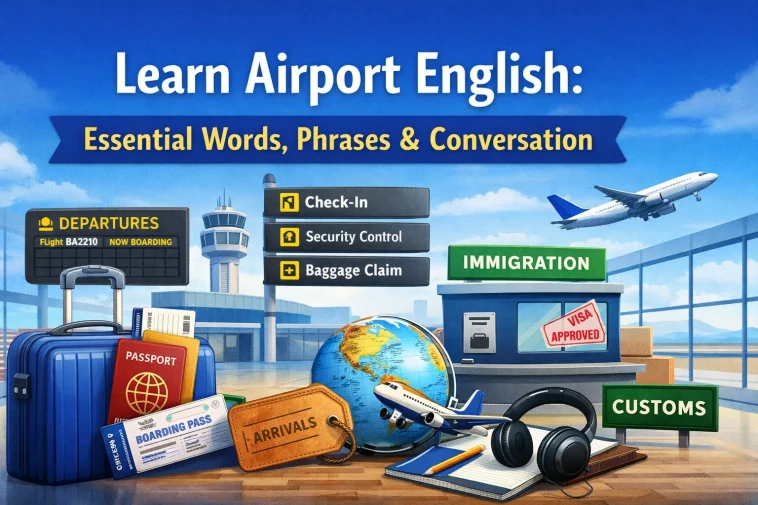
Navigating an airport can be stressful, especially if you’re unsure about what to say or expect. Mastering Airport English is the key to traveling confidently, understanding announcements, and communicating smoothly with airport staff.
This complete guide covers everything you need: essential airport vocabulary, practical English for airport situations, useful airport phrases, and real airport conversations to help you handle every scenario with ease.
Essential Airport Vocabulary You Must Know
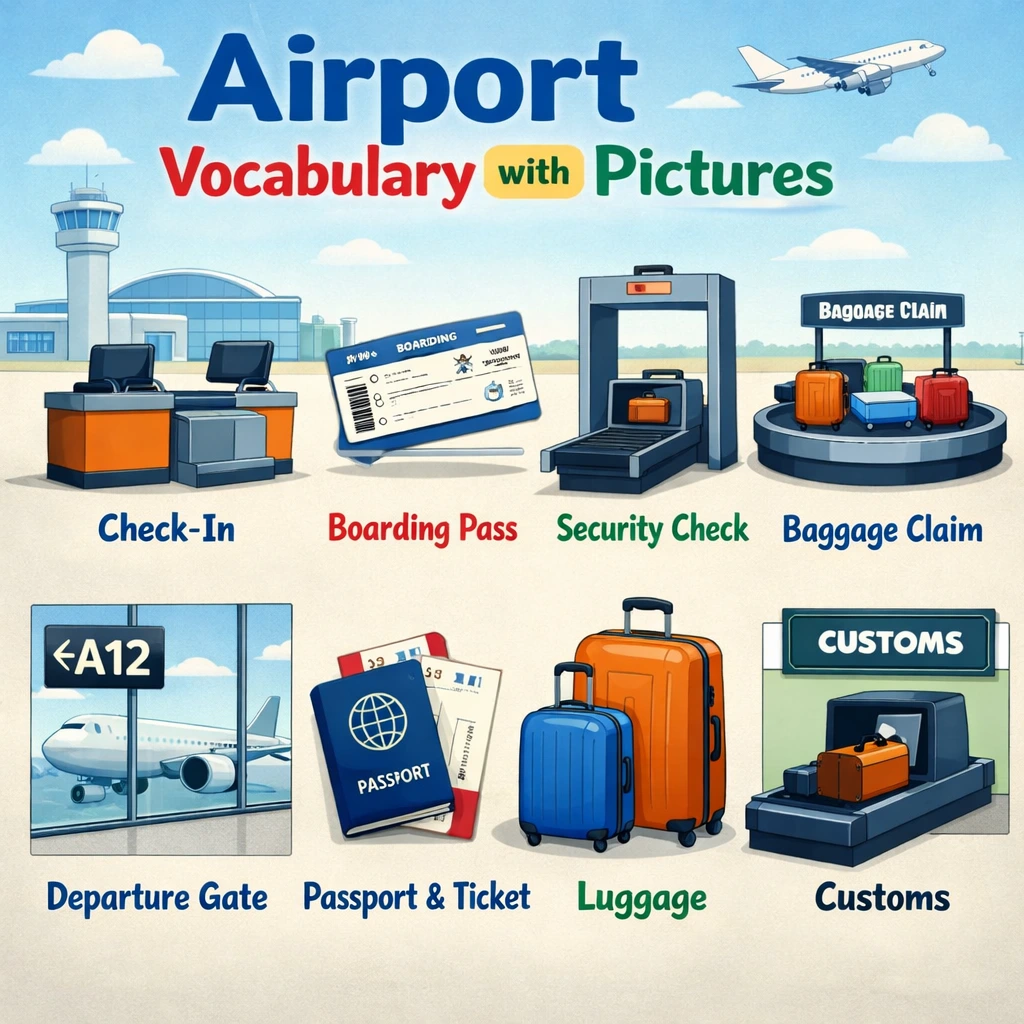
To speak confidently and navigate smoothly through any airport, mastering Airport English is essential. Knowing the key airport vocabulary helps you understand announcements, follow instructions, and communicate clearly with airport staff. Below is a list of the most important words you must know, along with their meanings and examples to help you practice effectively.
1. Terminal
Meaning: The main building at the airport where passengers arrive and depart.
Example: Please go to Terminal 2 for international flights.
2. Gate
Meaning: The area where passengers wait before boarding the plane.
Example: Our flight is boarding at Gate 23.
3. Departure Hall
Meaning: The area where passengers wait before going through security.
Example: Meet me in the departure hall.
4. Arrival Hall
Meaning: The area where passengers arrive after landing.
Example: Her family waited in the arrival hall.
5. Check-in Counter
Meaning: The place where passengers check in and get their boarding passes.
Example: Go to the check-in counter to get your ticket.
6. Security Checkpoint
Meaning: The area where passengers and their bags are checked.
Example: All passengers must pass the security checkpoint.
7. Immigration
Meaning: The place where passports are checked when entering a country.
Example: Show your passport at immigration.
8. Customs
Meaning: The area where luggage is checked after arrival.
Example: You must declare items at customs.
9. Lounge
Meaning: A comfortable waiting area for some passengers.
Example: We relaxed in the airport lounge.
10. Baggage Claim
Meaning: The area where passengers collect their luggage.
Example: My suitcase is at baggage claim.
For a complete list of essential words and phrases, check out 100 Airport Vocabulary & Expressions You Must Know.
English for Airport Situations
Traveling can be stressful if you don’t know what to say or expect. Learning Airport English for specific situations helps you communicate confidently and avoid confusion. Here are the main airport situations, common questions you may face, and suggested answers.
1. Check-in at the Airport
Situation: You arrive at the airport to check in for your flight.
Common Questions:
- “Do you have a reservation?”
- “May I see your passport and ticket?”
- “Would you like a window or aisle seat?”
Example Answers:
- “Yes, I have a reservation under the name John Smith.”
- “Here are my passport and ticket.”
- “I would like a window seat, please.”
Tips: Always have your documents ready and confirm your seat preference politely.
2. Security and Immigration
Situation: You need to pass through security screening and immigration control.
Common Questions at Security:
- “Please remove your laptop and liquids.”
- “Do you have any prohibited items?”
Example Answers:
- “Sure, here is my laptop and liquids in the tray.”
- “No, I do not have any prohibited items.”
Common Questions at Immigration:
- “What is the purpose of your visit?”
- “How long will you stay in the country?”
- “Do you have a visa?”
Example Answers:
- “I am here for tourism.”
- “I will stay for 5 days.”
- “Yes, here is my visa.”
Tips: Speak clearly, answer politely, and keep documents ready for inspection.
3. Boarding and Arrival
Situation: You are at the gate ready to board, or you have just arrived at your destination.
Common Questions at Boarding:
- “May I see your boarding pass?”
- “Do you need help with carry-on luggage?”
Example Answers:
- “Here is my boarding pass.”
- “Yes, please help me with my bag.”
Common Questions at Arrival:
- “Are you here on a connecting flight?”
- “Do you have anything to declare at customs?”
Example Answers:
- “Yes, I am catching a connecting flight to Paris.”
- “No, I don’t have anything to declare.”
Tips: Listen carefully to announcements and follow instructions. Always be polite to staff and ask for help if you’re unsure.
Common Airport Phrases Used in Real Life
Using the right airport phrases makes communication smoother and helps you handle different situations efficiently. This section separates phrases used by staff and passengers, so you can learn them in context.
Airport Phrases Used by Staff
- “Please have your documents ready.”
- When to hear it: At check-in, security, or immigration.
- Meaning: Prepare your passport, ticket, and any other required documents.
- “This way, please.”
- When to hear it: Guiding passengers through the terminal or security.
- Meaning: Follow the staff’s directions.
- “Your flight is now boarding.”
- When to hear it: At the gate before departure.
- Meaning: Boarding has started; it’s time to get on the plane.
- “May I see your passport?”
- When to hear it: At immigration or boarding.
- Meaning: The officer is requesting your passport for verification.
- “Follow the signs to baggage claim.”
- When to hear it: After landing.
- Meaning: Use the airport signs to find the luggage area.
Airport Phrases Used by Passengers
- “Where can I check in?”
- When to use it: When you arrive at the airport and need the check-in counter.
- “Can you help me, please?”
- When to use it: Asking for assistance with directions, luggage, or tickets.
- “I have a question about my flight.”
- When to use it: Clarifying flight details, delays, or gate numbers.
- “Where is the boarding gate?”
- When to use it: If you are unsure which gate to go to.
- “Is my flight on time?”
- When to use it: Checking the flight schedule with staff.
- “I missed my flight.”
- When to use it: Informing staff if you failed to board on time.
- “Can I change my seat?”
- When to use it: Requesting a different seat on the plane.
- “Thank you for your help.”
- When to use it: Showing politeness after assistance from airport staff.
Tips:
- Memorize phrases that fit your situation.
- Practice speaking them out loud to gain confidence.
- Use them along with the vocabulary you’ve learned for full Airport English mastery.
Airport Conversation and Dialogues in English
Learning Airport English is not just about vocabulary and phrases—it’s also about knowing how to have a conversation in real airport situations. Below are examples of common airport dialogues that will help you practice and feel confident.
Basic Airport Conversation for Beginners
Situation: Arriving at the check-in counter.
Passenger: “Good morning. I’d like to check in for Flight 210 to New York.”
Staff: “Good morning! May I see your passport and ticket, please?”
Passenger: “Here you go.”
Staff: “Thank you. Would you like a window or aisle seat?”
Passenger: “A window seat, please.”
Staff: “All done. Here’s your boarding pass. Your flight boards at Gate 12.”
Passenger: “Thank you very much!”
Tips: Use polite greetings and respond clearly with required information.
Real Airport Conversation Examples
Situation 1: At Security
Security Officer: “Please remove your laptop and liquids from your bag.”
Passenger: “Sure, here they are.”
Security Officer: “Do you have any prohibited items?”
Passenger: “No, I do not.”
Security Officer: “Thank you. You may go through the scanner now.”
Situation 2: At Immigration
Immigration Officer: “What is the purpose of your visit?”
Passenger: “I’m here for tourism.”
Immigration Officer: “How long will you stay in the country?”
Passenger: “Five days.”
Immigration Officer: “Do you have a visa?”
Passenger: “Yes, here it is.”
Situation 3: At Arrival and Customs
Customs Officer: “Are you carrying anything to declare?”
Passenger: “No, I’m not.”
Customs Officer: “Welcome. You may exit through the arrival hall.”
Passenger: “Thank you very much.”
Tips for Practicing Airport Conversations:
- Read the dialogues out loud to practice pronunciation.
- Role-play with a friend or record yourself to improve fluency.
- Combine the dialogues with airport phrases and vocabulary learned earlier.
- Pay attention to polite expressions and the proper sequence of questions and answers.
To practice more real-life dialogues, see our guide on Airport Conversation in English: Common Dialogues and Useful Phrases.
How to Improve Your Airport English Quickly
Mastering Airport English doesn’t happen overnight, but with the right approach, you can improve your skills fast. Here are practical tips and exercises to help you communicate confidently at the airport:
1. Learn Key Vocabulary Daily
- Focus on airport vocabulary like terminal, gate, boarding pass, baggage claim, and customs.
- Make a list of 5–10 words each day and review them aloud.
- Use flashcards or apps to reinforce memory.
Example Practice:
- “Terminal – the main building at the airport. I go to Terminal 2 for my flight.”
2. Practice Common Phrases
- Memorize essential airport phrases for both staff and passenger interactions.
- Repeat them out loud and try to use them in simulated conversations.
Example:
- Staff phrase: “Please have your documents ready.”
- Passenger phrase: “Where can I check in?”
3. Role-Play Real Situations
- Act out scenarios like check-in, security, boarding, and arrival with a friend or family member.
- This helps you get used to questions and responses you’ll encounter in real life.
Example Role-Play:
- Passenger: “May I have a window seat?”
- Staff: “Of course! Here’s your boarding pass.”
4. Listen to Airport Announcements
- Watch videos of airport announcements or listen to recordings online.
- Pay attention to vocabulary, pronunciation, and the structure of phrases.
Example Practice:
- “Flight BA210 is now boarding at Gate 12.”
- “All passengers must pass through security before departure.”
5. Combine Vocabulary with Visuals
- Use airport vocabulary with pictures to associate words with real airport objects and locations.
- This helps improve retention and recall during real situations.
6. Practice Speaking Every Day
- Even 5–10 minutes daily can improve fluency.
- Repeat dialogues, answer questions aloud, and practice polite responses.
- Gradually, you’ll be able to handle airport conversation in English naturally and confidently.
For a comprehensive set of travel words and practice exercises, see The Ultimate Travel Vocabulary Guide: 107 Words, Phrases & Practice Exercises.
Pro Tip: Keep a small notebook of new words and phrases during travel. Writing and reviewing them in context strengthens memory and boosts confidence in real-life airport English situations.
Frequently Asked Questions About Airport English (FAQ)
Here are the most common questions travelers and English learners have about Airport English, along with clear answers to help you communicate confidently in airports worldwide.
1. What is Airport English?
Answer:
Airport English refers to the English language used in airports, including vocabulary, phrases, and conversations. It covers check-in, security, boarding, arrival, and interactions with airport staff.
2. Why is learning Airport English important?
Answer:
Knowing Airport English helps you:
- Understand announcements and signs.
- Communicate effectively with staff.
- Handle unexpected situations, like flight delays or lost luggage.
- Reduce travel stress and improve your confidence.
3. How can I practice Airport English?
Answer:
You can practice by:
- Reviewing airport vocabulary daily.
- Learning and repeating common airport phrases.
- Role-playing airport conversations in English.
- Watching videos of real airport announcements.
4. What are the most useful Airport Phrases for passengers?
Answer:
Some essential phrases include:
- “Where can I check in?”
- “Is my flight on time?”
- “May I change my seat?”
- “Can you help me, please?”
- “Thank you for your help.”
5. What should I know about security and immigration in English?
Answer:
Learn key phrases like:
- “Please remove your shoes and electronics.”
- “Do you have any prohibited items?”
- “May I see your passport?”
- “Do you have a visa?”
These will make your Airport English experience smoother and reduce misunderstandings.
6. Are there resources to improve Airport English quickly?
Answer:
Yes! You can:
- Use flashcards for airport vocabulary with pictures.
- Practice dialogues from guides or apps.
- Listen to airport announcements in English.
- Role-play with friends or online language partners.
7. Can Airport English help with international travel?
Answer:
Absolutely! Most international airports use English as the main language for announcements, signage, and staff communication. Mastering Airport English ensures you can travel safely and confidently anywhere.
Tip: Combine vocabulary, phrases, and conversation practice daily to make Airport English second nature before your next trip.
Mastering Airport English is essential for every traveler. By learning the right airport vocabulary, practicing English for airport situations, and memorizing common airport phrases, you can navigate check-in, security, boarding, and arrivals confidently. Practicing real airport conversations in English will also help you respond naturally to questions and handle any situation with ease.
For travelers looking to expand their English skills beyond the airport, check out our guide on English for Hotel: Practical Vocabulary and Dialogues to learn essential hotel vocabulary and phrases that make your stay comfortable and stress-free.
Remember, consistent practice of Airport English—through vocabulary exercises, dialogues, and listening to announcements—will make your travel experience smoother, more enjoyable, and less stressful. Start practicing today and travel with confidence!