

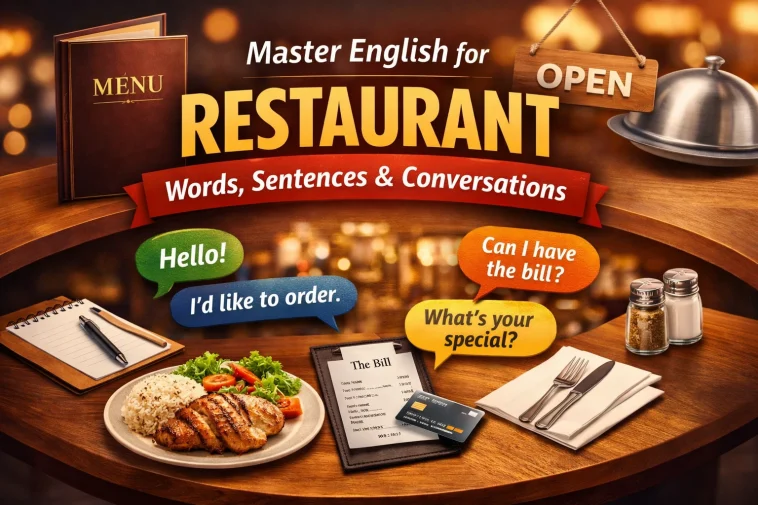
English for Restaurant is the key to speaking confidently in any dining situation. Whether you are a beginner or want to improve your fluency, knowing restaurant vocabulary, common restaurant phrases, and practical restaurant dialogues will make your meals stress-free and enjoyable.
This guide teaches essential restaurant words, everyday restaurant sentences, and real-life restaurant conversation English, helping you understand menus, talk to staff, and handle ordering and paying with ease.
By mastering these practical skills, you’ll feel confident in restaurants anywhere and turn every dining experience into a smooth and pleasant one.
Restaurant Vocabulary You Must Know
Understanding Restaurant Vocabulary is essential for anyone learning English for Restaurant. Below are common restaurant words with clear meanings and simple examples to help you use them in real restaurant situations.
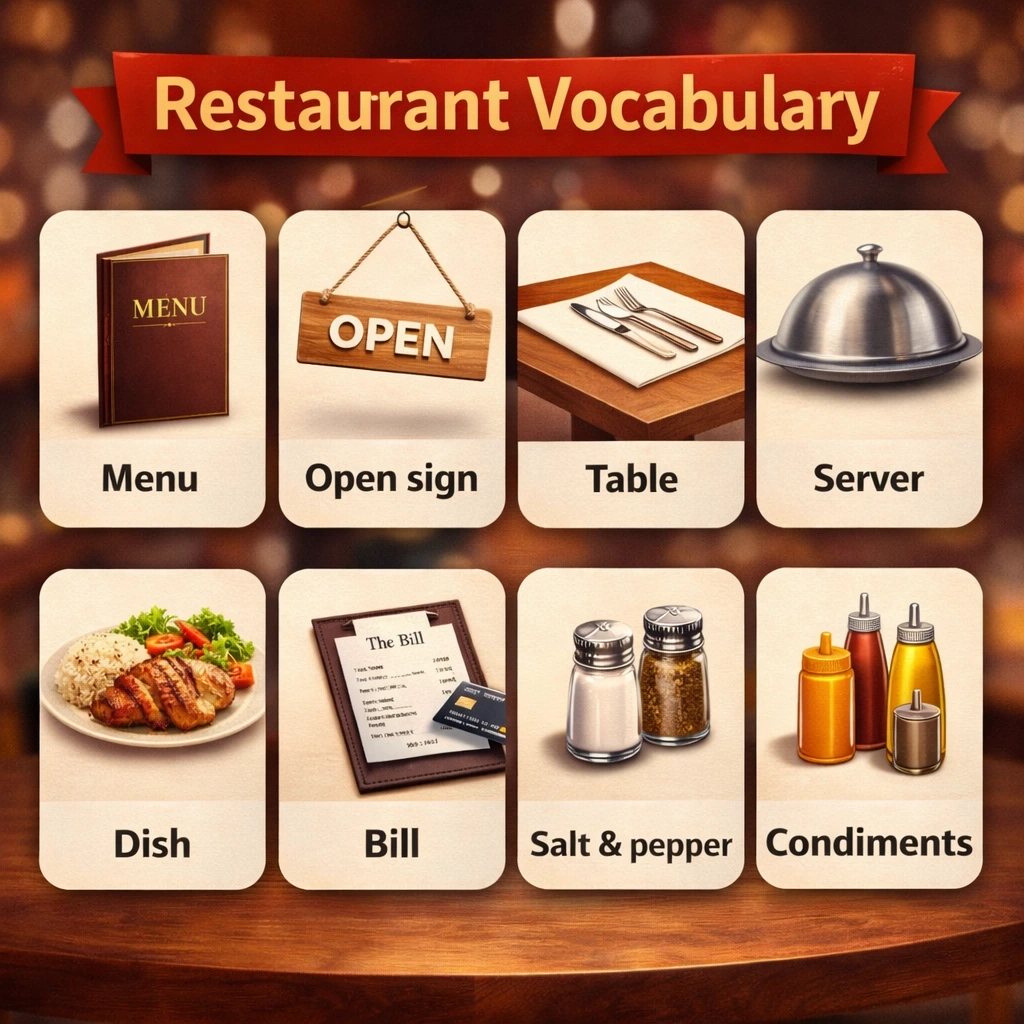
Restaurant Places and Objects Vocabulary
- Menu
Meaning: A list of food and drinks in a restaurant.
Example: Can I see the menu, please? - Table
Meaning: Furniture where customers eat their meals.
Example: Our table is near the window. - Chair
Meaning: A seat used at a table.
Example: Please take a chair. - Counter
Meaning: A long surface where orders or payments are made.
Example: You can pay at the counter. - Kitchen
Meaning: The place where food is prepared.
Example: The chef is in the kitchen.
Food and Meal Vocabulary
- Appetizer
Meaning: A small dish eaten before the main meal.
Example: We ordered an appetizer first. - Main course
Meaning: The main dish of the meal.
Example: The main course was very tasty. - Dessert
Meaning: Sweet food eaten after the meal.
Example: I want dessert after dinner. - Side dish
Meaning: Extra food served with the main dish.
Example: Fries are a side dish. - Drink
Meaning: A liquid you can drink.
Example: I’d like a cold drink.
Restaurant Staff Vocabulary
- Server
Meaning: A person who brings food and drinks to customers.
Example: The server took our order. - Host / Hostess
Meaning: A person who welcomes customers and shows them to a table.
Example: The host showed us our table. - Chef
Meaning: A person who cooks food professionally.
Example: The chef prepared the meal. - Manager
Meaning: A person who manages the restaurant.
Example: The manager helped us with the issue.
To expand your vocabulary even further, explore 70 Restaurant Vocabulary Words You Must Know in English for a complete list of essential restaurant words.
Common Restaurant Phrases for Everyday Situations
Knowing common Restaurant Phrases helps you communicate clearly in real-life restaurant situations. These phrases are widely used in English for Restaurant and make everyday restaurant sentences sound natural and polite.
Phrases for Arriving at the Restaurant
- “Do you have a table for two?”
Meaning: Asking if a table is available.
Example: Do you have a table for two, please? - “I have a reservation.”
Meaning: Saying you booked a table in advance.
Example: I have a reservation under Ahmed. - “Can we sit here?”
Meaning: Asking permission to sit at a specific table.
Example: Can we sit here by the window?
Phrases for Ordering Food and Drinks
- “Can I see the menu?”
Meaning: Asking for the menu.
Example: Can I see the menu, please? - “I’d like to order.”
Meaning: Saying you are ready to order food.
Example: I’d like to order now. - “What do you recommend?”
Meaning: Asking for a suggestion.
Example: What do you recommend today? - “I’ll have the chicken.”
Meaning: Choosing a dish.
Example: I’ll have the grilled chicken.
Phrases for During the Meal
- “Could I get some water?”
Meaning: Asking for a drink.
Example: Could I get some water, please? - “Can I get a refill?”
Meaning: Asking for more of the same drink.
Example: Can I get a refill on this? - “Everything is great, thank you.”
Meaning: Saying you are satisfied with the meal.
Example: Everything is great, thank you.
Phrases for Paying and Leaving
- “Can I have the bill, please?”
Meaning: Asking to pay.
Example: Can I have the bill, please? - “Do you accept credit cards?”
Meaning: Asking about payment methods.
Example: Do you accept credit cards? - “Thank you, have a nice day.”
Meaning: Polite phrase when leaving.
Example: Thank you, have a nice day.
For more useful phrases to use in restaurants, see 56 Restaurant Phrases in English for Real Conversations, which covers essential expressions for ordering, paying, and making requests.
Restaurant Dialogues for Real-Life Conversations
Learning restaurant dialogues helps you understand how real restaurant conversation English sounds in everyday situations. These examples show how complete restaurant dialogue in English flows naturally between customers and staff.
Dialogue 1: Arriving and Getting a Table
Customer: Good evening. Do you have a table for two?
Host: Yes, we do. Do you have a reservation?
Customer: No, we don’t.
Host: That’s fine. Please follow me.
Customer: Thank you.
This type of restaurant dialogue is very common and helps you feel comfortable when entering a restaurant.
Dialogue 2: Ordering Food
Server: Are you ready to order?
Customer: Yes. I’ll have the soup as an appetizer.
Server: And for the main course?
Customer: I’ll have the grilled chicken, please.
Server: Great choice.
This example shows how restaurant dialogue English is polite, simple, and direct.
Dialogue 3: During the Meal
Customer: Excuse me, could I get some water?
Server: Of course. I’ll bring it right away.
Customer: Thank you.
Short exchanges like this are an important part of restaurant conversation English.
Dialogue 4: Paying and Leaving
Customer: Can I have the bill, please?
Server: Sure. I’ll be right back.
Customer: Do you accept credit cards?
Server: Yes, we do.
Customer: Thank you.
Understanding these restaurant dialogues helps you handle the full dining experience with confidence.
To practice more real-life conversations, check our full guide Restaurant Dialogues: Real English Conversations for Dining for additional examples and dialogues.
English for Restaurant Practice and Tips
Practicing English for Restaurant regularly is the best way to speak confidently in real-life situations. By combining restaurant vocabulary, restaurant phrases, and restaurant dialogues, you can communicate naturally and politely.
Practical Tips for Beginners
- Start Small: Focus on simple restaurant sentences first, like ordering drinks or asking for a table.
- Repeat Dialogues: Practice common restaurant dialogues out loud to improve pronunciation and fluency.
- Use Real-Life Situations: Try speaking in English when visiting cafes or casual restaurants to get used to real interactions.
- Listen and Learn: Watch videos or listen to English-speaking servers to understand natural conversation flow.
- Combine Vocabulary and Phrases: Use words like menu, main course, or server in complete restaurant sentences for practice.
- Practice Politeness: Phrases like “please”, “thank you”, and “excuse me” make your English sound natural and polite.
- Role-Play: Practice with a friend or teacher acting as the server to simulate real restaurant conversation English.
By following these tips and practicing regularly, you will feel more confident using English for Restaurant. You’ll be able to read menus, order food, make requests, pay the bill, and enjoy a smooth dining experience in any English-speaking restaurant.
Mastering English for Restaurant is essential for anyone who wants to communicate confidently in dining situations. By learning restaurant vocabulary, practicing restaurant phrases, and studying real restaurant dialogues, you can order food, ask questions, make requests, and pay the bill politely and naturally. Regular practice will help you understand menus faster, speak clearly to staff, and handle any restaurant scenario with confidence.
Using these skills together—vocabulary, phrases, and dialogues—creates a strong foundation for real-life restaurant conversation English. To further enhance your language skills in the hospitality field, you can explore English for Hotel: Practical Vocabulary and Dialogues, a comprehensive guide for hotel interactions and practical English conversations.