
Learning how to ask questions is one of the most important parts of English communication. Present simple questions are used every day to talk about routines, habits, and general facts, making them a key grammar topic for beginners and intermediate learners.
In this guide, you will learn how to form questions in simple present tense using clear and easy-to-remember formulas. The article explains the structure of Yes/No questions with do and does, as well as Wh-questions using words like what, where, when, why, and how. You will also see examples of simple present tense questions and answers to help you understand how these questions work in real conversations.
By the end of this article, you will understand the correct structure of simple present questions, avoid common grammar mistakes, and feel confident asking questions in everyday English.
What Are Present Simple Questions?
Present simple questions are questions we use to ask about daily routines, habits, general facts, and regular activities. They are formed using the auxiliary verbs do and does together with the base form of the main verb.
In English grammar, these questions usually ask about things that happen regularly or are always true.
Examples of Present Simple Questions
- Do you like coffee?
- Does she work in an office?
- Do they play football on weekends?
- Does he read books every day?
In these examples, the verbs do and does help form the question, while the main verb stays in its base form (like, work, play, read).
When Do We Use Present Simple Questions?
We use questions in simple present tense to ask about:
1. Daily routines
- Do you wake up early?
- Does she go to school by bus?
2. Habits
- Do they drink coffee every morning?
- Does he exercise regularly?
3. General facts
- Does the sun rise in the east?
- Do birds fly south in winter?
If you want to see more real examples of how this tense is used in everyday sentences, you can check our guide Simple Present Tense Examples for Everyday English, which includes many clear examples of the present simple.
Present Simple Questions and Short Answers
Many simple present questions are answered with short answers.
Examples:
- Do you like tea?
→ Yes, I do. - Does she work here?
→ No, she doesn’t. - Do they study English?
→ Yes, they do.
Short answers help conversations sound more natural and fluent.
If you would like to practice making these questions yourself, you can try our interactive activities in Present Simple Questions – Exercises with Answers and Interactive Present Simple Exercises for Daily English, where you will find practical exercises with answer keys.
For younger learners, there are also simplified activities in Present Simple Exercises for Kids, designed to make grammar practice easy and engaging.
Now that you understand what present simple questions are, let’s look at the clear formulas used to build them correctly.
Present Simple Questions Formula
To form present simple questions, English uses a clear and simple structure. Many learners find it helpful to remember the question formulas like small grammar equations.
These formulas make it easier to create simple present questions, whether they are Yes/No questions or Wh-questions.
Yes/No Question Formula
The basic formula for Yes/No questions in the present simple is:
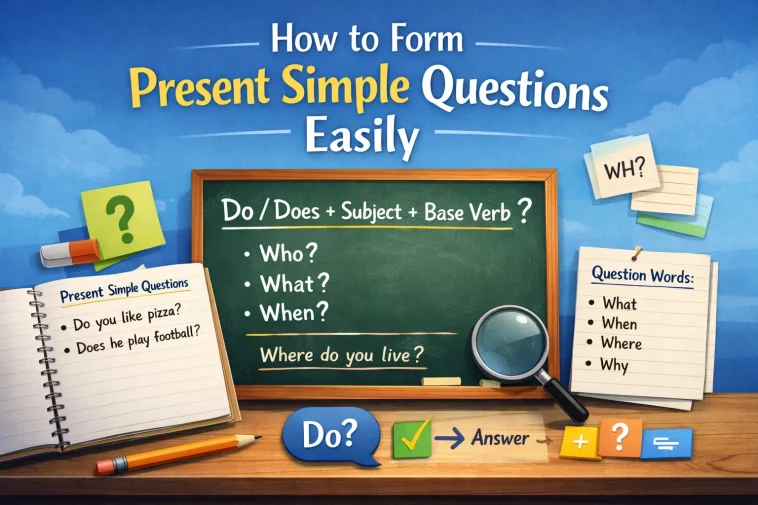
Do / Does + Subject + Base Verb + ?
| Auxiliary | Subject | Base Verb | Example |
|---|---|---|---|
| Do | you | like | Do you like coffee? |
| Do | they | play | Do they play football? |
| Does | she | work | Does she work here? |
| Does | he | read | Does he read books? |
Important rule:
After do or does, the main verb must stay in the base form.
Correct:
✔ Does she like tea?
Incorrect:
✘ Does she likes tea?
Wh-Question Formula
When we want specific information, we use Wh-questions.
The formula is:
Wh-word + Do / Does + Subject + Base Verb + ?
| Wh-Word | Auxiliary | Subject | Verb | Example |
|---|---|---|---|---|
| What | do | you | eat | What do you eat for breakfast? |
| Where | do | they | live | Where do they live? |
| When | does | she | start | When does she start work? |
| Why | do | you | study | Why do you study English? |
| How | does | he | travel | How does he travel to work? |
These formulas help learners clearly understand how questions in simple present tense are built.
Once you remember these two structures, it becomes much easier to create simple present tense questions and answers correctly.
In the next section, we will look more closely at Yes/No questions in the present simple, including tables that show how do and does change depending on the subject.
Yes/No Questions in the Present Simple
Yes/No questions are the most common type of present simple questions. They are called Yes/No questions because they can usually be answered with Yes or No.
These questions follow a clear grammatical structure.
Yes/No Question Structure
The basic structure is:
Do / Does + Subject + Base Verb + ?
Examples:
- Do you like pizza?
- Do they study English?
- Does she work here?
- Does he play football?
In these questions in simple present tense, the verb do or does appears at the beginning of the sentence to form the question.
Table: Auxiliary Verbs in Present Simple Questions
The auxiliary verb changes depending on the subject.
| Subject | Auxiliary | Example Question |
|---|---|---|
| I | do | Do I need a ticket? |
| You | do | Do you like coffee? |
| We | do | Do we start now? |
| They | do | Do they live here? |
| He | does | Does he work here? |
| She | does | Does she play tennis? |
| It | does | Does it rain a lot here? |
This table helps learners understand the correct structure for simple present questions.
Present Simple Questions and Short Answers
Many simple present tense questions and answers use short answers instead of repeating the full sentence.
| Question | Short Answer |
|---|---|
| Do you like tea? | Yes, I do. / No, I don’t. |
| Does she work here? | Yes, she does. / No, she doesn’t. |
| Do they play football? | Yes, they do. / No, they don’t. |
| Does he watch TV? | Yes, he does. / No, he doesn’t. |
These present simple questions and short answers are very common in everyday English conversations.
Short answers make communication clear, natural, and efficient.
Now that you understand how Yes/No questions work, let’s move to the second major type of present simple questions: Wh-questions, which help us ask for specific information such as time, place, reason, or method.
Wh-Questions in the Present Simple
While Yes/No questions ask for a simple confirmation, Wh-questions are used when we want specific information. These questions usually begin with a question word, such as what, where, when, why, or how.
These are very common questions on simple present tense, especially in everyday conversations.
Wh-Question Structure
The structure for simple present tense questions with Wh-words is:
Wh-word + do/does + subject + base verb + ?
Examples:
- Where do you live?
- What does she eat for breakfast?
- When do they start work?
- Why do you study English?
- How does he travel to school?
In this structure, the auxiliary verb (do/does) still appears before the subject, just like in Yes/No questions.
Common Wh-Words in Present Simple Questions
| Question Word | Purpose | Example Question |
|---|---|---|
| What | ask about things or actions | What do you eat for breakfast? |
| Where | ask about place | Where do they live? |
| When | ask about time | When does she start work? |
| Why | ask about reason | Why do you learn English? |
| How | ask about method | How do you go to school? |
These question words help create simple present questions that request more detailed information.
Examples of Simple Present Tense Questions and Answers
Here are some examples of present simple tense questions and answers:
- Where do you work?
→ I work in a hospital. - What does she do after school?
→ She plays the piano. - When do they study English?
→ They study English in the evening. - How does he go to work?
→ He goes to work by bus.
These examples show how Wh-questions allow us to ask about time, place, actions, and reasons in the present simple tense.
Common Mistakes in Present Simple Questions
When learners start forming present simple questions, they often make a few common grammar mistakes. Understanding these errors helps you build correct and natural questions in simple present tense.
Below are the most frequent mistakes and the correct forms.
1. Adding -s to the Main Verb After Does
One of the most common mistakes in simple present tense questions is adding -s to the main verb when the auxiliary does is already used.
Incorrect:
❌ Does she likes coffee?
Correct:
✔ Does she like coffee?
Explanation:
When we use does, the main verb must stay in the base form.
2. Using the Wrong Auxiliary Verb
Another common mistake is using do instead of does, or the opposite.
Incorrect:
❌ Do he play football?
Correct:
✔ Does he play football?
Rule:
- Use do with I, you, we, they
- Use does with he, she, it
3. Forgetting the Auxiliary Verb
Some learners try to form questions without using do or does.
Incorrect:
❌ You like coffee?
Correct:
✔ Do you like coffee?
In English, most simple present questions require the auxiliary do or does.
4. Incorrect Word Order
The word order in present simple questions must always follow the correct structure.
Incorrect:
❌ Where you live?
Correct:
✔ Where do you live?
Correct formula:
Wh-word + do/does + subject + base verb
Quick Tip
Whenever you create questions on simple present tense, remember these three key rules:
- Use do or does at the beginning of the question.
- Keep the main verb in the base form.
- Follow the correct word order.
Quick Summary
Let’s review the most important points about present simple questions.
Yes/No Question Formula
Do/Does + Subject + Base Verb + ?
Examples:
- Do you like coffee?
- Does she work here?
Wh-Question Formula
Wh-word + Do/Does + Subject + Base Verb + ?
Examples:
- Where do you live?
- What does he do?
By understanding these structures, learners can easily form simple present questions, ask for information, and answer correctly in everyday English conversations.
Conclusion
Understanding present simple questions is an essential step for building strong English communication skills. By learning the clear formulas for Yes/No questions and Wh-questions, learners can easily ask about daily routines, habits, and general facts in correct and natural English.
The key points to remember are simple: use do with I, you, we, they and does with he, she, it, always keep the main verb in its base form, and follow the correct question structure. Once these rules are clear, forming questions in simple present tense becomes much easier.
If you want to see how the present simple fits into the complete system of English grammar, you can also read All tenses in English: A Simple Guide, which explains all the main English tenses in a clear and structured way.