
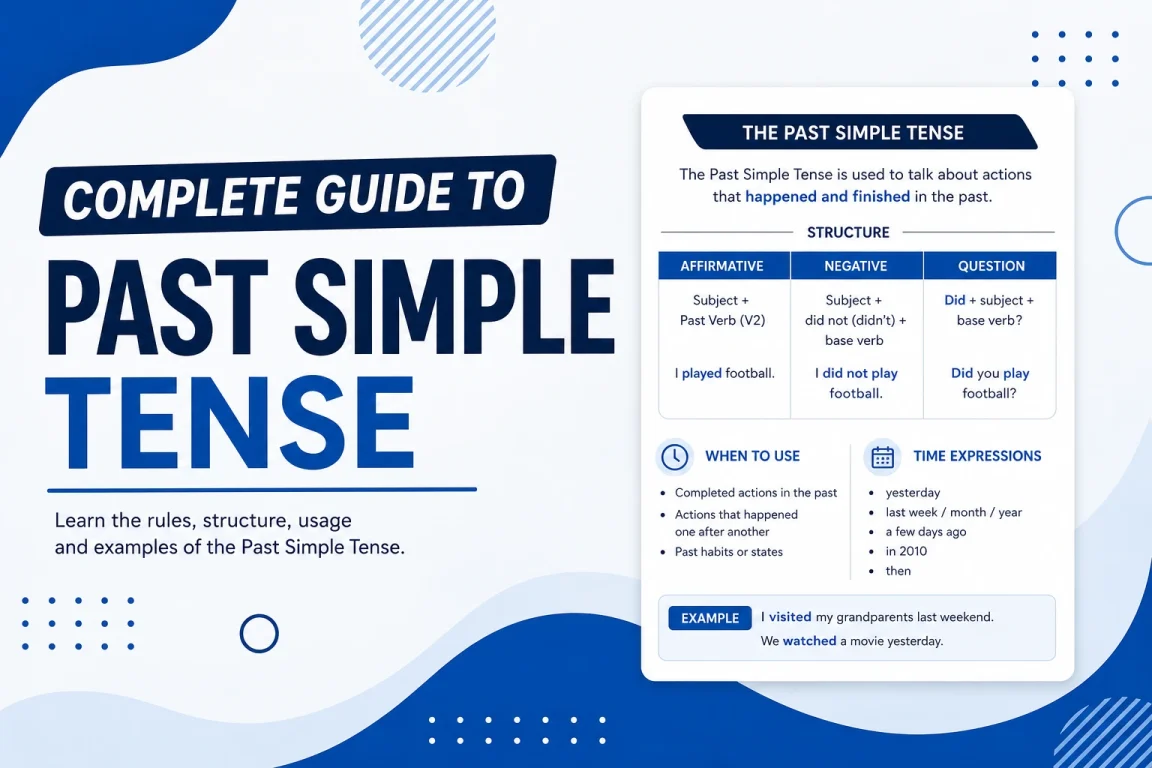
The Past Simple Tense is one of the most important grammar topics in English because it helps you talk about completed actions, past experiences, and real-life situations. In this guide, you will learn the rules, structure, examples, questions, negatives, and practice exercises to master the Past Simple Tense step by step.
What Is the Past Simple Tense?
The Past Simple Tense is used to describe actions or events that happened and finished in the past.
It is one of the most important tenses in English because it helps you talk about past experiences clearly and correctly.
For example:
- I visited my friend yesterday.
- She watched a movie last night.
- They went to the park last weekend.
These sentences show completed actions, which is the main use of the simple past. If you want to see more real usage, you can explore our Simple Past Tense Examples guide for detailed sentence structures.
When Do We Use the Past Simple?
We use the past simple in several common situations:
1. Completed actions in the past
- I finished my homework.
- She cleaned the room.
2. Actions at a specific time
- They arrived at 8 PM.
- He left yesterday.
3. A sequence of past events
- I woke up, brushed my teeth, and went to school.
4. Past habits or repeated actions
- We played football every weekend.
- She visited her grandparents often.
Time expressions often used with the past simple tense include:
yesterday, last night, last week, last year, ago
Understanding when to use this tense is the first step to mastering it. To practice what you’ve learned, you can check our Past Simple Exercises for hands-on activities.
Past Simple Structure
Understanding the past simple structure is essential for forming correct sentences in English.
Once you learn the basic pattern, you can easily create positive, negative, and question sentences.
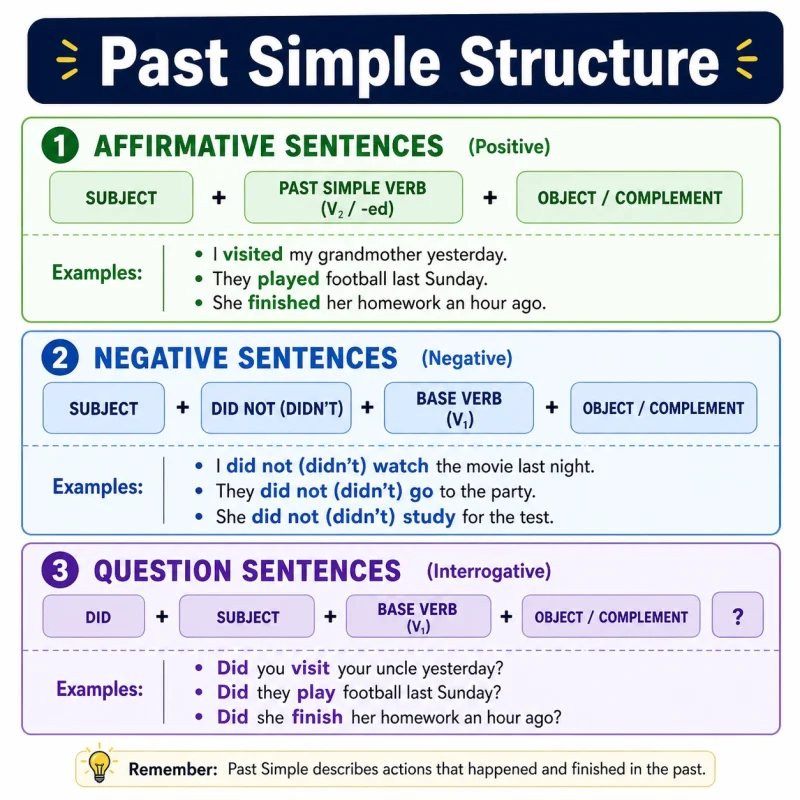
Past Simple Tense Formula
The past simple tense formula for affirmative sentences is:
Subject + past verb (V2)
Examples:
- I played football yesterday.
- She watched a movie last night.
- They visited their grandparents.
For regular verbs, we usually add -ed (play → played, watch → watched).
For irregular verbs, the form changes (go → went, eat → ate).
To learn more about verb types, you can check our guide on past simple regular and irregular verbs for a detailed explanation.
Affirmative Sentences
Affirmative sentences are used to describe actions that happened in the past.
Examples:
- I finished my homework.
- She cleaned her room.
- They traveled to Spain.
- He bought a new phone.
- We studied English yesterday.
These sentences follow a simple and clear structure, making the past simple one of the easiest tenses to use.
If you want to focus specifically on regular verb patterns, you can explore our Past Simple Regular Verbs Exercises with Answers for more examples and practice.
Past Simple Negative
The past simple negative is used to talk about things that did not happen in the past.
It is an essential part of the past simple tense, especially for clear and accurate communication.
How to Form Negative Sentences
To form negative sentences in the simple past, we use:
Subject + did not (didn’t) + base verb
Examples:
- I did not go to school yesterday.
- She didn’t finish her homework.
- They did not watch the movie.
Important rule: after didn’t, always use the base form of the verb, not the past form.
If you want a deeper explanation with more patterns, you can check our Past Simple Negative guide for detailed rules and structures.
Common Negative Examples
Here are some common simple past negative sentences:
- I didn’t eat breakfast this morning.
- She didn’t call me yesterday.
- They didn’t play football after school.
- We didn’t understand the lesson.
- He didn’t buy a new phone.
These examples help you see how negatives are used in everyday situations.
To practice more, you can explore our simple past negative sentences article, which includes many examples and exercises for better understanding.
Past Simple Questions
Past simple questions are used to ask about actions that happened in the past.
They are essential for conversations, helping you get information and interact naturally in English.
Yes/No Questions
Yes/No questions are questions that can be answered with yes or no.
Structure:
Did + subject + base verb?
Examples:
- Did you go to school yesterday?
- Did she finish her homework?
- Did they watch the movie?
Short Answers:
- Yes, I did. / No, I didn’t.
- Yes, she did. / No, she didn’t.
Important: after did, always use the base verb, not the past form.
To practice more question forms, you can check our Past Simple Questions guide for detailed explanations and examples.
WH Questions
WH questions ask for specific information using words like what, where, when, why, who, and how.
Structure:
WH word + did + subject + base verb?
Examples:
- What did you do yesterday?
- Where did she go last weekend?
- When did they arrive?
- Why did he leave early?
- How did you learn English?
These types of questions are very common in everyday communication.
To improve your skills, you can also try our past simple questions exercises for more practice and real examples.
Simple Past Tense Examples
Learning through simple past tense examples is one of the fastest ways to understand how the tense works in real life.
These examples show how to use the past simple naturally in everyday situations.
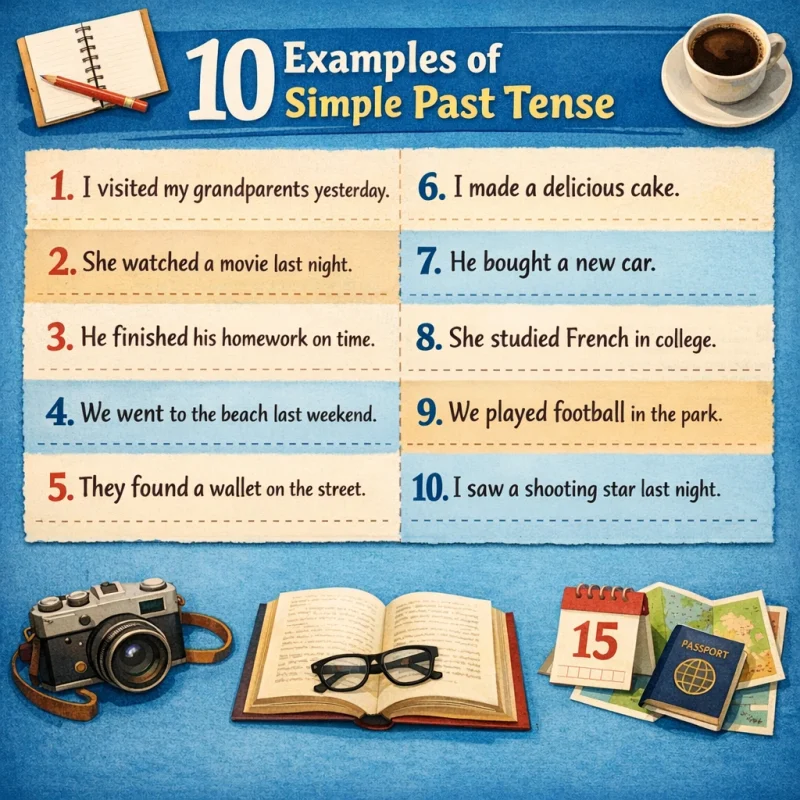
Everyday Sentences
Here are common sentences using the simple past:
- I woke up early yesterday.
- She went to work by bus.
- They had lunch at a restaurant.
- We watched a movie last night.
- He finished his homework on time.
- I met my friend after school.
- She cooked dinner for her family.
- They played football in the park.
- We visited our grandparents last weekend.
- He bought a new laptop.
These examples help you see how actions are expressed clearly in the past.
For more detailed lists, you can explore our Simple past tense examples article with more sentences and variations.
Questions and Answers
Using questions and answers helps you practice real conversations with the past simple tense.
Examples:
- What did you do yesterday?
→ I studied for my exam. - Where did she go last weekend?
→ She went to the beach. - When did they arrive?
→ They arrived at 7 PM. - Why did he leave early?
→ He felt sick. - Did you watch the movie?
→ Yes, I did. - Did she finish her homework?
→ No, she didn’t.
These examples combine both past simple questions and answers, making them useful for daily communication.
Past Simple Regular and Irregular Verbs
Understanding past simple regular and irregular verbs is essential for using the tense correctly.
Verbs in the past simple change in two different ways: some follow a rule, while others do not.
Past Simple Regular Verbs
Past simple regular verbs follow a simple rule: we add -ed to the base verb.
Examples:
- play → played
- watch → watched
- clean → cleaned
- visit → visited
- work → worked
Example sentences:
- I played football yesterday.
- She watched a movie last night.
- They cleaned the house.
Be careful with spelling changes:
- stop → stopped
- study → studied
If you want a full explanation and more examples, check our Past simple regular and irregular verbs guide for detailed rules and lists.
Simple Past Irregular Verbs
Simple past irregular verbs do not follow a fixed rule, so they must be memorized.
Examples:
- go → went
- eat → ate
- see → saw
- take → took
- buy → bought
Example sentences:
- I went to the park.
- She ate breakfast early.
- They saw a movie.
These verbs are very common in English, so learning them is important for fluency.
To practice and memorize them faster, you can explore our Simple past irregular verbs article with lists, examples, and exercises.
Past Simple Exercises
Practicing regularly is the best way to master the past simple tense.
These past simple exercises are organized by level to help you improve step by step.
Practice for Beginners (A1)
If you are just starting, focus on simple sentences and basic verb forms.
Beginner exercises help you understand how to use regular verbs and form correct sentences.
Examples:
- I played football yesterday.
- She watched TV last night.
To get structured beginner practice, you can explore our Past Simple Exercises A1 article with easy activities and answers.
Intermediate Practice (B1)
At the intermediate level, exercises become more complex and include longer sentences and irregular verbs.
You will also practice negative sentences and questions.
Examples:
- I went to the store and bought some food.
- She didn’t finish her work because she was tired.
For more advanced practice, check our Past Simple Exercises B1 guide to improve your fluency and accuracy.
Exercises for Kids
For young learners, exercises should be simple, fun, and engaging.
Using games and easy sentences helps children learn faster.
Examples:
- I played with my friends.
- She helped her mom.
You can find fun and interactive activities in our Past Simple Exercises for Kids article, designed to make learning enjoyable and effective.
Common Mistakes in Past Simple
When learning the past simple tense, many learners make common mistakes that affect accuracy.
Understanding these errors will help you improve faster and use English more naturally.
Verb Form Mistakes
One of the most frequent mistakes is using the wrong verb form.
Incorrect:
- I go to school yesterday.
- She eat breakfast this morning.
- They seen the movie.
Correct:
- I went to school yesterday.
- She ate breakfast this morning.
- They saw the movie.
Another common error is adding -ed to irregular verbs:
Incorrect:
- I goed to the park.
- She buyed a phone.
Correct:
- I went to the park.
- She bought a phone.
Confusing Tenses
Learners often confuse the past simple with other tenses, especially the present or present perfect.
Incorrect:
- I have seen that movie yesterday.
- She goes to school last week.
Correct:
- I saw that movie yesterday.
- She went to school last week.
Remember:
- Use past simple for finished actions in the past
- Use time expressions like yesterday, last week, last year
If you want to improve your understanding further, you can explore our Past Simple Questions Exercises with Answers to see how this tense works in different sentence types.
Tips to Master the Past Simple Tense
Mastering the Past Simple Tense becomes much easier when you practice consistently and use it in real situations.
The key is not just memorizing rules, but applying them every day.
Daily Practice Methods
Daily practice helps you build confidence and accuracy with the past simple tense.
Try these simple methods:
- Write 5 sentences every day about your past activities
- Keep a small diary in English (Yesterday I…)
- Practice with flashcards of regular and irregular verbs
- Do short past simple exercises regularly to reinforce grammar rules
Consistency is more important than long study sessions. Even 10 minutes a day can make a big difference.
Learning Through Real Examples
Learning through real-life examples helps you remember grammar naturally instead of memorizing rules.
For example:
- I went to the supermarket yesterday.
- She watched a movie last night.
- They didn’t come to school because they were sick.
- Did you finish your homework?
You can also strengthen your understanding by exploring related topics like Simple past tense examples, Past simple questions, and Past simple negative structures to see how the tense works in different contexts.
Using real sentences regularly will help you master the Past Simple Tense faster and use it confidently in speaking and writing.
Mastering the Past Simple Tense requires understanding its structure and practicing it in different forms such as sentences, questions, and exercises. With consistent practice and real-life usage, you can improve your fluency and confidence in English quickly.