

Are you looking for simple present tense examples to improve your English? This article is a complete reference with clear and easy sentences for beginners and learners at level A2. You will find examples for daily routines, habits, facts, schedules, questions, and negative sentences, all in simple and understandable English.
Use these examples to practice, learn, and speak English confidently, and quickly see how the simple present tense works in everyday situations.
By the end of this guide, you will have all the essential examples you need to master the simple present tense.
Simple Present Tense Examples (Basic Sentences)
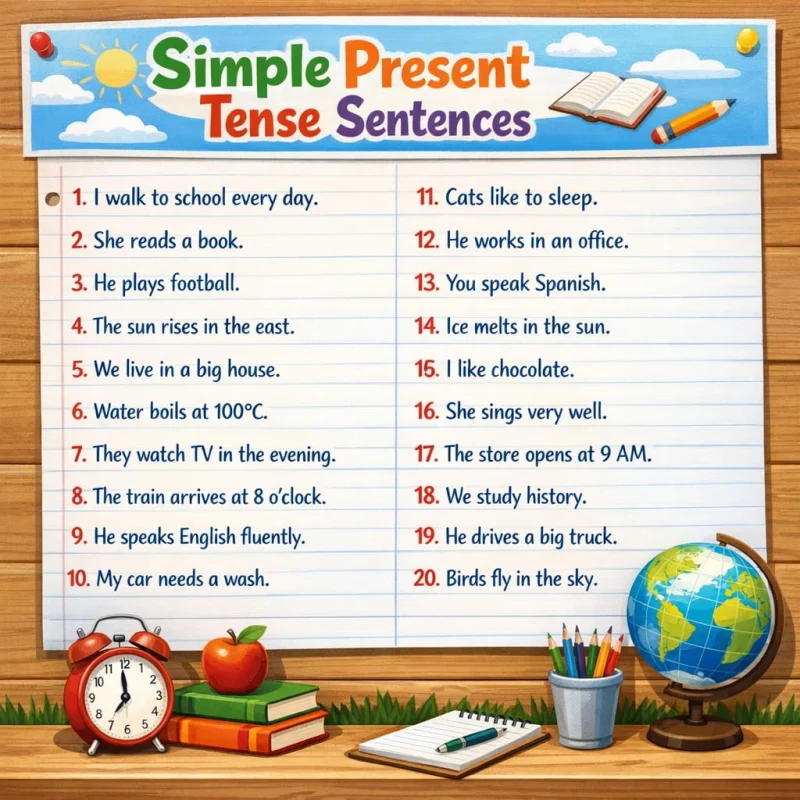
The following simple present tense examples show how we use this tense in short and clear sentences. These examples are easy to read and help you see how the verb works in everyday English.
In each sentence, the main verb is highlighted in bold.
Basic Simple Present Tense Sentences
- I eat breakfast at 7 a.m.
- She likes coffee.
- They play football after school.
- He works in a small office.
- We watch TV in the evening.
- The sun rises in the east.
- I read English books every day.
- My brother drives to work.
- Birds fly in the sky.
- She studies English at home.
More Simple Present Tense Sentences Examples
- I drink tea in the morning.
- He runs in the park every day.
- We live in a big city.
- My teacher explains the lesson clearly.
- They open the shop at 9 a.m.
- She writes in her notebook.
- The baby cries at night.
- My father reads the newspaper every morning.
- We learn new words in class.
- The bus stops near my house.
These simple present tense sentences examples show common actions, daily activities, and general facts. The simple present tense is often used to talk about things that happen regularly or things that are always true.
Simple Present Tense Sentences Examples for Daily Life
We often use the simple present tense to talk about daily activities. These actions happen regularly at home, at school, or at work.
Below are simple present tense sentences examples that show common actions in everyday life. The main verb in each sentence is in bold.
Daily Routine Examples
- I wake up at 7 a.m.
- She brushes her teeth after breakfast.
- He takes a shower in the morning.
- We eat lunch at noon.
- They go to work by bus.
- I drink coffee every morning.
- She prepares dinner for her family.
- He checks his email at work.
- We study English in the evening.
- They watch TV after dinner.
Examples at Home
- I clean my room on Saturday.
- My mother cooks delicious meals.
- My father reads the newspaper every morning.
- My sister listens to music in her room.
- We eat dinner together every night.
Examples at School or Work
- The teacher starts the class at 9 a.m.
- Students ask questions during the lesson.
- I write notes in my notebook.
- My friend helps me with homework.
- The manager checks the reports every day.
These simple present tense examples show how we describe everyday actions and routines. This tense is very common when we talk about things we do regularly in our daily life.
Simple Present Tense Examples for Habits
We often use the simple present tense to talk about habits. A habit is something a person does regularly or usually does.
The following simple present tense examples show common habits. The main verb in each sentence is in bold.
Examples of Personal Habits
- I drink coffee every morning.
- She exercises before work.
- He reads a book every night.
- I check my phone many times a day.
- She writes in her journal every evening.
- He takes a walk after dinner.
- I practice English every day.
- She listens to music while studying.
- He plays chess on weekends.
- I review my lessons before bed.
Examples of Healthy Habits
- She drinks a lot of water every day.
- He runs in the park every morning.
- They eat fresh fruit every day.
- I sleep eight hours every night.
- She does yoga in the morning.
Examples of Study Habits
- I study English for one hour every day.
- She reviews her notes after class.
- He asks questions during the lesson.
- They practice speaking in English class.
- My friend learns five new words every day.
These simple present tense sentences examples describe actions that happen regularly or repeatedly, which is why the simple present tense is commonly used for habits and routines.
Simple Present Tense Examples for Facts
We also use the simple present tense to talk about facts. These are things that are always true or generally true.
The following simple present tense examples show facts about nature, science, and the world. The main verb in each sentence is in bold.
Examples of General Facts
- The sun rises in the east.
- Water boils at 100°C.
- The Earth moves around the sun.
- Birds fly in the sky.
- Fish live in water.
- Plants need sunlight to grow.
- Ice melts in heat.
- The moon orbits the Earth.
- Light travels very fast.
- Rain falls from clouds.
Examples of Scientific Facts
- Humans need oxygen to live.
- The heart pumps blood through the body.
- The brain controls the body.
- Water freezes at 0°C.
- The Earth has one moon.
Examples of World Facts
- Paris is the capital of France.
- The Amazon River flows through South America.
- China has a large population.
- The Sahara Desert covers a large area of Africa.
- The Pacific Ocean is the largest ocean on Earth.
These simple present tense sentences examples show how we use this tense to describe facts and general truths that do not change.
Simple Present Tense Examples for Schedules
We also use the simple present tense to talk about schedules and timetables. These sentences describe events that happen at a fixed or planned time, such as train times, school schedules, or daily programs.
Below are simple present tense examples that show how we talk about schedules.
Examples of Transport Schedules
- The train leaves at 8 a.m.
- The bus arrives at the station at 9:30 a.m.
- The flight departs at 6 p.m.
- The train stops at the next station.
- The plane lands at the airport at noon.
Examples of School Schedules
- The class starts at 9 a.m.
- The lesson ends at 10:30 a.m.
- The break begins at 11 a.m.
- The teacher gives homework on Friday.
- The school opens at 8 a.m.
Examples of Event Schedules
- The meeting begins at 3 p.m.
- The movie starts at 7 p.m.
- The show ends at 9 p.m.
- The concert takes place on Saturday.
- The event opens at 10 a.m.
These simple present tense sentences examples show how the simple present tense is often used for timetables, programs, and scheduled events.
Simple Present Tense Examples with He, She, and It
When the subject is he, she, or it, the verb in the simple present tense usually adds -s or -es. These subjects are called third-person singular.
The following simple present tense examples show how verbs change with he, she, and it.
Examples with He
- He works in a hospital.
- He drinks coffee every morning.
- He plays football after school.
- He drives to work every day.
- He reads the news online.
Examples with She
- She teaches English at school.
- She watches TV in the evening.
- She likes chocolate.
- She studies English every day.
- She writes emails to her friends.
Examples with It
- The dog barks at strangers.
- The cat sleeps on the sofa.
- The baby cries at night.
- The machine works very fast.
- The phone rings loudly.
Mixed Examples
- My brother plays the guitar.
- The teacher explains the lesson clearly.
- The shop opens at 9 a.m.
- The train arrives on time.
- The computer runs many programs.
These simple present tense sentences examples show how verbs change with he, she, and it by adding -s or -es in the simple present tense.
Simple Present Tense Question Examples
In English, we often use the simple present tense to ask questions about daily actions, habits, and facts. These questions usually begin with Do or Does.
The following simple present tense examples show common questions.
Questions with Do
We use Do with I, you, we, and they.
- Do you like coffee?
- Do they play football after school?
- Do you work on weekends?
- Do we have English class today?
- Do they live near the school?
- Do you watch TV in the evening?
- Do we start the meeting at 10 a.m.?
- Do they study English every day?
- Do you drink tea in the morning?
- Do they visit their grandparents often?
Questions with Does
We use Does with he, she, and it.
- Does he work in this office?
- Does she speak English well?
- Does he play the guitar?
- Does she teach English?
- Does the train arrive at 8 a.m.?
- Does the shop open on Sunday?
- Does he read books every day?
- Does she drink coffee in the morning?
- Does the dog bark at strangers?
- Does the bus stop near your house?
These simple present tense sentences examples show how we ask questions about daily actions, habits, and regular events using the simple present tense.
Simple Present Tense Negative Sentence Examples
We use negative sentences in the simple present tense to say that something does not happen or is not true. Negative sentences usually use do not (don’t) or does not (doesn’t).
The following simple present tense examples show how we form negative sentences. The main verb is highlighted in bold.
Negative Sentences with Don’t
We use don’t with I, you, we, and they.
- I do not eat fast food every day.
- You do not work on Sunday.
- We do not watch TV in the morning.
- They do not play football after school.
- I do not drink coffee at night.
- You do not live near the office.
- We do not start class late.
- They do not visit the museum often.
- I do not read the newspaper every day.
- We do not buy expensive clothes.
Negative Sentences with Doesn’t
We use doesn’t with he, she, and it.
- He does not like spicy food.
- She does not drink coffee.
- He does not work on weekends.
- She does not watch TV every day.
- The dog does not bark at night.
- The shop does not open on Sunday.
- He does not play basketball.
- She does not drive to work.
- The bus does not stop here.
- The machine does not work properly.
These simple present tense sentences examples show how we use do not and does not to make negative sentences in the simple present tense.
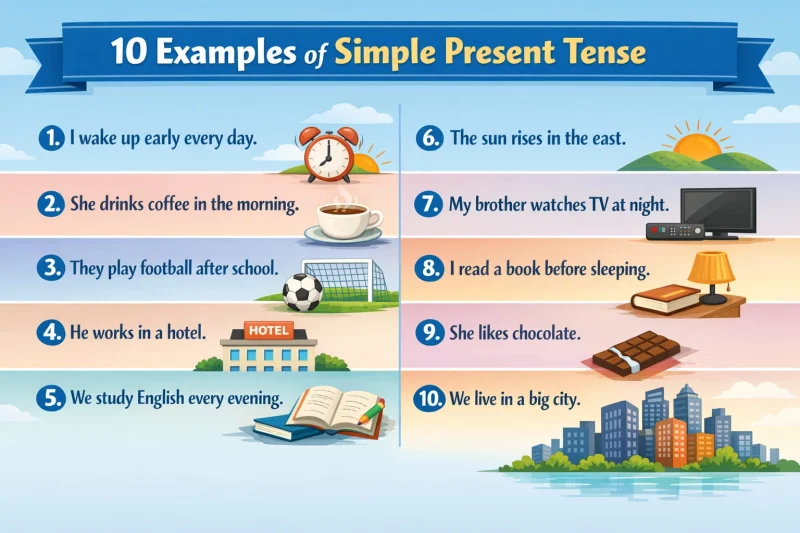
10 Examples of Simple Present Tense Sentences
Below are 10 examples of simple present tense sentences. These sentences show how we use the simple present tense to talk about daily actions, habits, and general facts.
The main verb in each sentence is highlighted in bold.
- I wake up early every day.
- She drinks coffee in the morning.
- He works in a big company.
- We study English at school.
- They play football after class.
- The teacher explains the lesson clearly.
- My brother drives to work every day.
- The sun rises in the east.
- Birds build nests in trees.
- The train arrives at the station at 6 p.m.
These simple present tense sentences examples help learners see how this tense is used in clear and practical situations in everyday English.
Quick List of Simple Present Tense Examples
Below is a quick list of simple present tense examples. These short sentences help learners quickly see how the simple present tense is used in everyday English.
- I eat breakfast at 7 a.m.
- She likes chocolate.
- He plays football on weekends.
- We study English every day.
- They watch TV in the evening.
- The sun rises in the east.
- Birds fly in the sky.
- The teacher teaches English.
- My father works in a bank.
- My mother cooks dinner every night.
- I read books before bed.
- She drinks tea in the morning.
- He runs in the park every day.
- We live in a big city.
- They open the shop at 9 a.m.
- The baby cries at night.
- The bus stops near my house.
- The dog barks at strangers.
- Students learn new words in class.
- The train leaves at 8 a.m.
This quick list of simple present tense sentences examples provides many short and clear sentences that show how the simple present tense appears in everyday communication.
Conclusion
In this article, we shared many simple present tense examples for daily life, habits, facts, schedules, questions, and negative sentences. These examples help learners see the simple present tense in action and make it easier to use in real situations.
Remember, the simple present tense is used for:
- Daily routines and habits
- General facts and truths
- Schedules and timetables
By practicing these simple present tense sentences, you can improve your English quickly and confidently.
For a complete understanding of all English tenses, check out our full guide here: All tenses in English: A Simple Guide. This guide explains all tenses with examples and helps you use English correctly in any situation.