

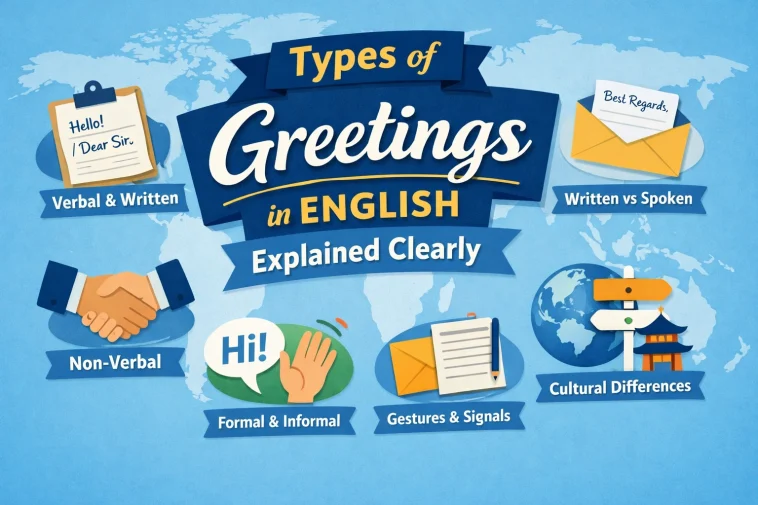
Types of greetings form the foundation of social communication in English. From spoken and written expressions to non-verbal gestures, greetings help establish tone, respect, and connection. This guide explores the main types of greetings in English in a clear, structured way to support effective and appropriate communication across different contexts.
1. What Are Greetings? (Definition and Purpose)
Greetings are the first forms of social interaction used to acknowledge another person’s presence and start communication politely. They help establish tone, show respect, and signal the type of relationship between speakers (formal, friendly, or casual).
In language learning, understanding greetings is essential because they appear in almost every conversation. For learners who want practical examples of how greetings are used in real life, see English Phrases for Daily Use, which shows how greetings function in everyday communication.
2. Verbal Types of Greetings
Verbal greetings rely on language to initiate interaction. They can be spoken face to face or written in messages and emails, and their form changes depending on context, relationship, and social expectations.
2.1 Formal Verbal Greetings
Used in professional, academic, or official contexts
Formal verbal greetings are structured, polite, and respectful. They are commonly used in workplaces, academic institutions, official events, and professional emails. These greetings help establish credibility and show awareness of social hierarchy.
Typical characteristics include:
- Complete expressions rather than short words
- Use of titles and surnames
- Neutral and professional tone
To explore safe and correct professional usage in detail, see Formal Greetings in English: Professional Phrases for Work and Academia.
2.2 Informal Verbal Greetings
Used with friends, family, and familiar people
Informal verbal greetings are friendly and relaxed. They are used in everyday conversations with people you know well and help create closeness and comfort.
Common features:
- Short and simple language
- Warm and personal tone
- Flexible usage in spoken communication
If you want to see how informal greetings sound natural in daily life, read Greeting Phrases in English: Speak Naturally and Confidently.
2.3 Casual and Slang Greetings
Everyday and relaxed greetings in social settings
Casual and slang greetings are highly informal and often culture- or age-specific. They are common in spoken English, especially among close friends, peers, or in relaxed social environments.
Key traits:
- Very short forms or abbreviations
- Strong dependence on context
- Not suitable for professional or formal situations
For a quick overview of short, modern greeting expressions, you can refer to 10 Different Greetings in English for Everyday Conversations.
3. Non-Verbal Types of Greetings
Greetings expressed through body language
Non-verbal greetings communicate meaning without words. They often accompany verbal greetings, but in some situations they can stand alone. These greetings are especially important when language barriers exist or when social norms limit verbal interaction.
3.1 Handshakes
Professional and polite non-verbal greetings
Handshakes are one of the most widely recognized non-verbal greetings, especially in professional and formal contexts. They are commonly used in business meetings, interviews, and official introductions.
Key characteristics:
- Signal respect and professionalism
- Usually brief and firm
- Often combined with eye contact
The appropriateness of a handshake can depend on culture and setting.
3.2 Waves, Nods, and Gestures
Simple and distance-friendly greetings
Waving, nodding, or using small hand gestures are common non-verbal greetings when people are at a distance or when speaking is unnecessary.
Common uses include:
- Greeting someone across a room
- Acknowledging acquaintances
- Informal social situations
These gestures are generally neutral and flexible but may vary in meaning across cultures.
3.3 Facial Expressions (Smiles, Eye Contact)
Universal non-verbal greeting signals
Facial expressions play a central role in greetings. A smile or brief eye contact can function as a greeting even without words.
Important points:
- Smiles often signal friendliness and openness
- Eye contact shows attention and respect
- Overuse or avoidance can change the message
Facial expressions are among the most universal forms of greeting but are still influenced by cultural norms.
4. Written vs Spoken Greetings
How greetings change between emails, messages, and face-to-face communication
Greetings take different forms depending on whether they are written or spoken. The medium affects tone, structure, and level of formality, making it important to choose the right type of greeting for each situation.
Written greetings are commonly used in emails, letters, and messages. They are usually more structured and carefully worded because they create a lasting impression.
- Often more formal and polite
- Frequently include full phrases and titles
- Used in professional, academic, and official contexts
Spoken greetings are used in face-to-face conversations or phone calls. They tend to be more flexible and influenced by tone of voice and body language.
- Can be formal or informal
- Often shorter and more natural
- Supported by non-verbal signals such as smiles or gestures
Understanding the difference between written and spoken greetings helps avoid misunderstandings and ensures appropriate communication in different environments.
5. Types of Greetings in English Across Cultures
Greetings in English may look simple, but their meaning and appropriateness can change across cultures. While English is spoken globally, cultural norms strongly influence how, when, and to whom greetings are used.
Key cultural differences include:
- Personal space: Some cultures prefer distance, others expect closeness
- Formality levels: Certain cultures favor formal greetings longer than others
- Non-verbal behavior: Eye contact, smiling, or handshakes may be encouraged or limited
For learners, starting with neutral and widely accepted greeting vocabulary is safest. To build a strong foundation of basic greeting vocabulary before adapting to cultural nuance, see Greeting Words in English: Common, Formal & Friendly Vocabulary.
6. How to Choose the Right Type of Greeting
Choosing the correct greeting depends on context rather than language alone. A good greeting reflects awareness of situation, relationship, and setting.
Consider the following:
- Who are you greeting? (colleague, friend, stranger)
- Where are you? (workplace, social event, public space)
- How are you communicating? (email, in person, message)
When unsure, it is best to choose a polite and neutral greeting, especially in professional or multicultural environments.
7. Summary: Understanding the Main Types of Greetings
Understanding the types of greetings helps build confident and appropriate communication. Greetings can be:
- Verbal (formal, informal, casual)
- Non-verbal (gestures, facial expressions)
- Written or spoken, depending on the medium
- Culturally influenced, even within English
By viewing greetings as a structured system rather than isolated phrases, learners can develop stronger social and linguistic awareness.
Conclusion
Understanding the different types of greetings helps learners communicate with clarity and confidence. By recognizing when to use verbal, non-verbal, written, or spoken greetings—and how culture influences them—you can choose the most appropriate greeting for any situation and interact more effectively in English.