
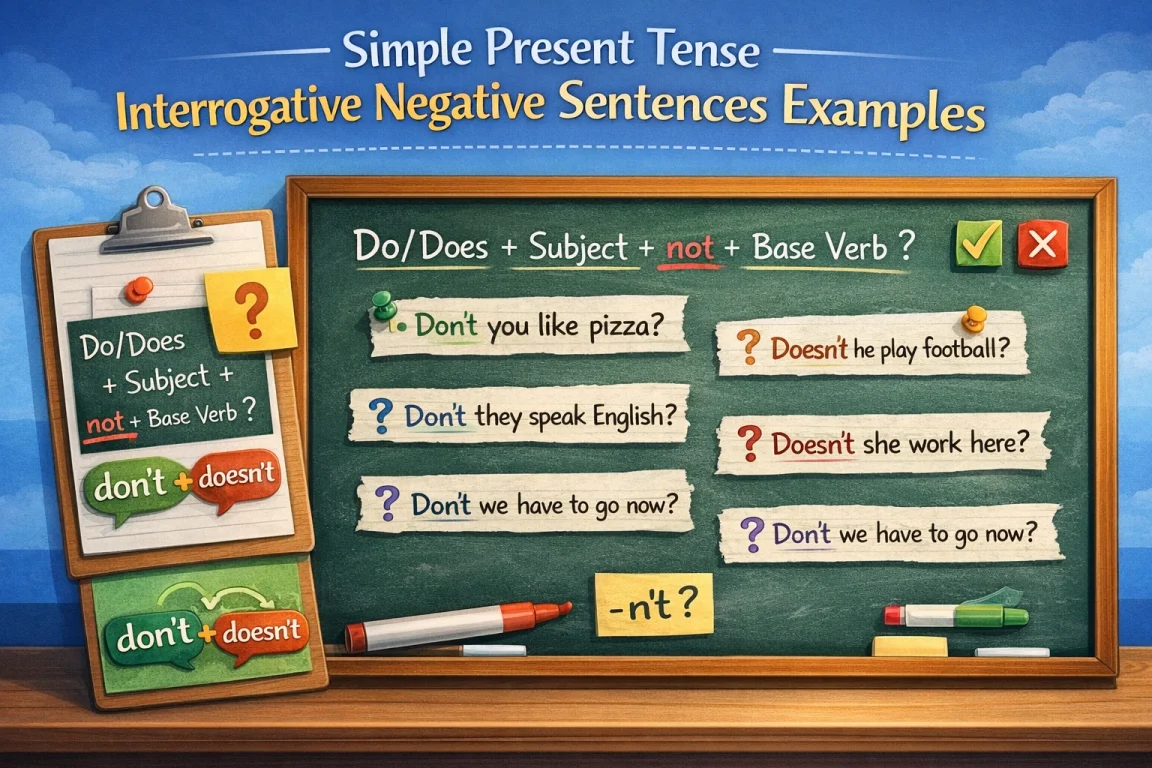
In English grammar, interrogative negative sentences combine a question form with a negative meaning. In the simple present tense, these questions are formed using do / does with not, or their contracted forms don’t and doesn’t.
Understanding this structure helps learners ask questions that show surprise, confirmation, or expectation. For example:
- Don’t you like coffee?
- Doesn’t she work here?
In this guide, you will find clear explanations and several simple present tense interrogative negative sentences examples to help you understand how these questions are formed and used in everyday English.
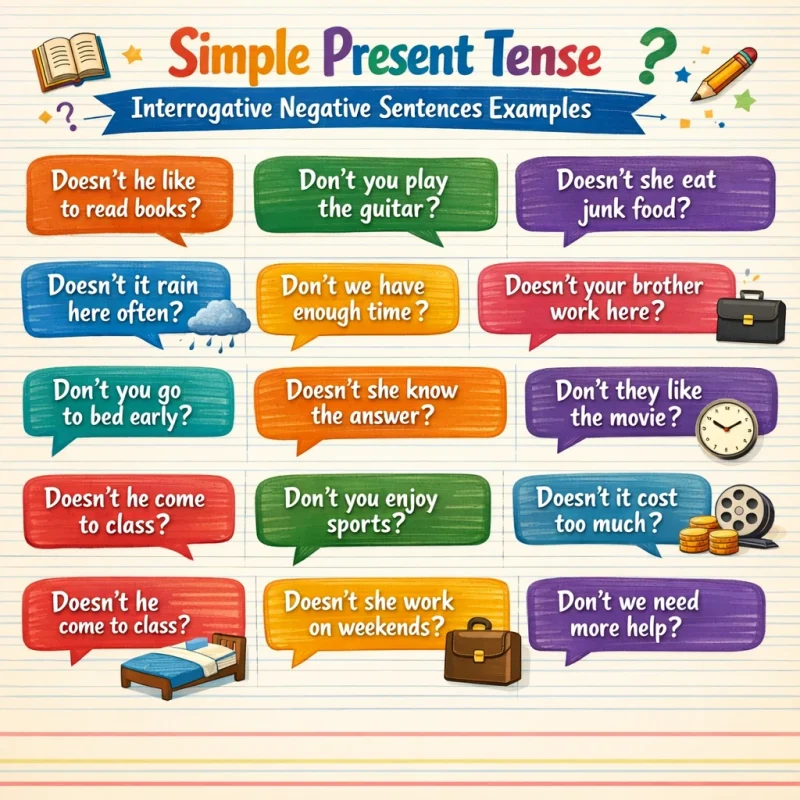
What Are Interrogative Negative Sentences in the Present Simple?
In English grammar, interrogative negative sentences are questions that include a negative form such as not, don’t, or doesn’t. These questions are used when the speaker expects a certain answer or wants to express surprise, doubt, or confirmation.
In the simple present tense, interrogative negative questions are formed using the auxiliary verbs do or does with not.
Basic Examples
- Do you not like coffee?
- Does she not work here?
- Don’t they play football on weekends?
- Doesn’t he watch TV at night?
These sentences combine two elements:
- Interrogative form → a question structure
- Negative form → using not, don’t, or doesn’t
Why Do We Use Interrogative Negative Questions?
These questions are often used to:
1. Express surprise
- Don’t you like chocolate?
2. Confirm something
- Doesn’t she live near here?
3. Show expectation
- Don’t they study English at school?
Understanding these structures becomes easier when you first know how normal present simple questions work. If you want a complete explanation of question structures, you can read our guide Present Simple Questions, which explains the formulas for both Yes/No questions and Wh-questions in detail.
Now that you know what interrogative negative sentences in the present simple are, let’s look at the exact structure used to build them correctly.
Structure of Simple Present Interrogative Negative Sentences
To form simple present tense interrogative negative sentences, we combine the question structure with the negative form. This means we use the auxiliary verbs do or does together with not.
There are two common structures: the full form and the contracted form.
1. Full Form Structure
The basic formula is:
Do / Does + subject + not + base verb + ?
Examples:
- Do you not understand the question?
- Does she not work on Sundays?
- Do they not play football after school?
In this structure, the word not appears after the subject.
2. Contracted Form Structure
In everyday English, we often use contractions.
The formula becomes:
Don’t / Doesn’t + subject + base verb + ?
Examples:
- Don’t you like pizza?
- Doesn’t he study English?
- Don’t they live near here?
This form is more natural in spoken English and is used frequently in conversations.
Table: Auxiliary Verbs in Interrogative Negative Questions
| Subject | Auxiliary | Example |
|---|---|---|
| I / You / We / They | Don’t | Don’t you like coffee? |
| He / She / It | Doesn’t | Doesn’t she work here? |
Important rule:
After do, does, don’t, or doesn’t, the main verb must stay in the base form.
Correct:
✔ Doesn’t she like tea?
Incorrect:
✘ Doesn’t she likes tea?
If you want to see more examples of how the present simple tense works in everyday sentences, you can explore our guide Simple Present Tense Examples for Everyday English, which includes many clear examples of this tense in real situations.
Now let’s look at several simple present tense interrogative negative sentences examples to understand how these questions appear in real English usage.
Simple Present Tense Interrogative Negative Sentences Examples
Below are several simple present tense interrogative negative sentences examples. These questions combine interrogative form (a question) with a negative form, usually using don’t or doesn’t.
Examples with Don’t
These examples use don’t with the subjects I, you, we, and they.
- Don’t you like coffee?
- Don’t they work on weekends?
- Don’t we have a meeting today?
- Don’t you study English every day?
These questions are often used when the speaker expects the answer to be yes.
Example:
- Don’t you live near here?
→ Yes, I do.
Examples with Doesn’t
These examples use doesn’t with he, she, and it.
- Doesn’t she work in an office?
- Doesn’t he play football after school?
- Doesn’t your brother like pizza?
- Doesn’t the store open at 9 a.m.?
Example with an answer:
- Doesn’t she live in London?
→ Yes, she does.
Interrogative Negative Questions with Surprise
Sometimes these questions express surprise or disbelief.
Examples:
- Don’t you know the answer?
- Doesn’t he understand the problem?
- Don’t they speak English here?
These simple present questions help speakers show that they expected a different situation.
If you want to practice building these types of questions yourself, you can try the exercises in Present Simple Questions – Exercises with Answers, where you will find structured practice and answer keys.
Next, let’s look at some common mistakes learners make when forming interrogative negative questions in the present simple.
Common Mistakes in Interrogative Negative Questions
When learners form simple present tense interrogative negative sentences, they sometimes make small grammar mistakes. Knowing these common errors helps you build correct and natural questions.
1. Adding -s to the Main Verb
One of the most frequent mistakes is adding -s to the verb after doesn’t.
Incorrect:
❌ Doesn’t she likes coffee?
Correct:
✔ Doesn’t she like coffee?
Rule:
After do, does, don’t, or doesn’t, the main verb must stay in the base form.
2. Using the Wrong Auxiliary Verb
Another common mistake is using don’t with he, she, or it.
Incorrect:
❌ Don’t he play football?
Correct:
✔ Doesn’t he play football?
Rule:
- Don’t → I, you, we, they
- Doesn’t → he, she, it
3. Incorrect Word Order
Sometimes learners place not in the wrong position.
Incorrect:
❌ Do not you like coffee?
Correct:
✔ Do you not like coffee?
✔ Don’t you like coffee?
The contracted form (don’t / doesn’t) is more common in everyday English.
Understanding these small details helps you form accurate simple present questions. If you want to explore how these questions fit within the complete system of English grammar, you can read All tenses in English: A Simple Guide, which explains the main tenses and their structures in a clear and simple way.