
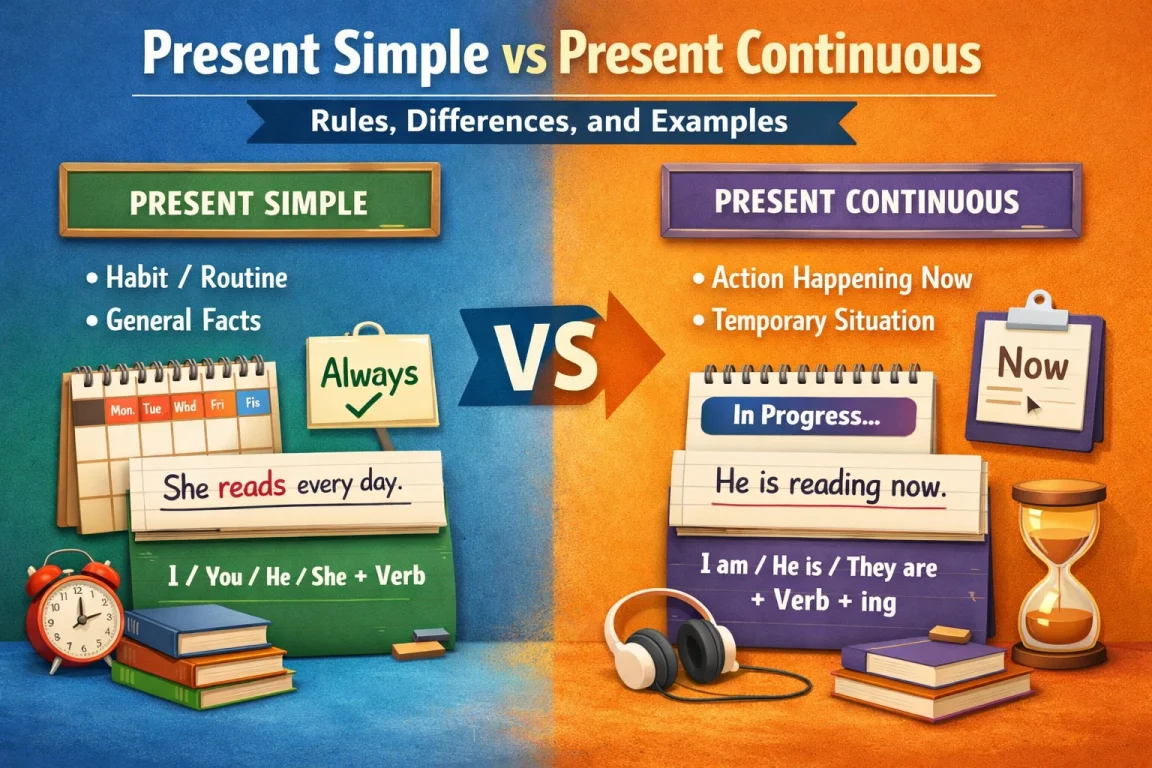
Understanding the difference between present simple vs present continuous is essential for speaking and writing English clearly. The present simple tense is used for habits, routines, and general facts, while the present continuous tense describes actions happening now or temporary situations.
In this guide, you will learn the rules, structures, and signal words that make choosing the correct tense easy. We also provide side-by-side examples to help you see the difference in real sentences. By the end, you’ll confidently know when to use each tense and avoid common mistakes.
What Is the Difference Between Present Simple and Present Continuous?
The main difference between present simple and present continuous is when and how the action happens.
- Present simple is used for things that happen regularly (daily routines, habits, general facts).
- Present continuous is used for actions happening right now or at the moment of speaking.
Quick Comparison Examples
- I work every day. → (present simple = routine)
- I am working now. → (present continuous = happening now)
- She reads books. → (habit)
- She is reading a book now. → (action happening now)
Simple Explanation
- Use present simple for things that are always true or repeated.
- Use present continuous for things happening now or temporarily.
If you want to review more examples of the present simple in real life, you can read Simple Present Tense Examples for Everyday English.
Now that you understand the basic difference, let’s look at the rules of present simple vs present continuous in a clear and easy way.
Present Simple vs Present Continuous Rules
To clearly understand the difference between these two tenses, it is important to learn the rules of present simple vs present continuous.
Present Simple Rules
We use the present simple for:
- Daily routines
→ I wake up at 7 a.m. - Habits
→ She drinks coffee every morning. - General facts
→ The sun rises in the east. - Permanent situations
→ They live in London.
Present Continuous Rules
We use the present continuous for:
- Actions happening now
→ I am studying English now. - Temporary actions
→ She is working in a café this week. - Trends or changing situations
→ More people are using the internet. - Actions happening around now (not exactly this moment)
→ They are learning a new language.
Key Difference
- Present simple → repeated, regular, or permanent actions
- Present continuous → happening now or temporary actions
If you want to practice these rules, you can try Present Simple Questions – Exercises with Answers, where you will find exercises to strengthen your understanding.
Next, let’s look at a clear structure comparison between present simple and present continuous to make the difference even easier to understand.
Structure Comparison (Simple vs Continuous)
Understanding the structure helps you clearly see the difference between present simple and present continuous.
Comparison Table
| Tense | Structure | Example |
|---|---|---|
| Present Simple | Subject + base verb (or verb + -s) | She works every day. |
| Present Continuous | Subject + am/is/are + verb + -ing | She is working now. |
More Examples
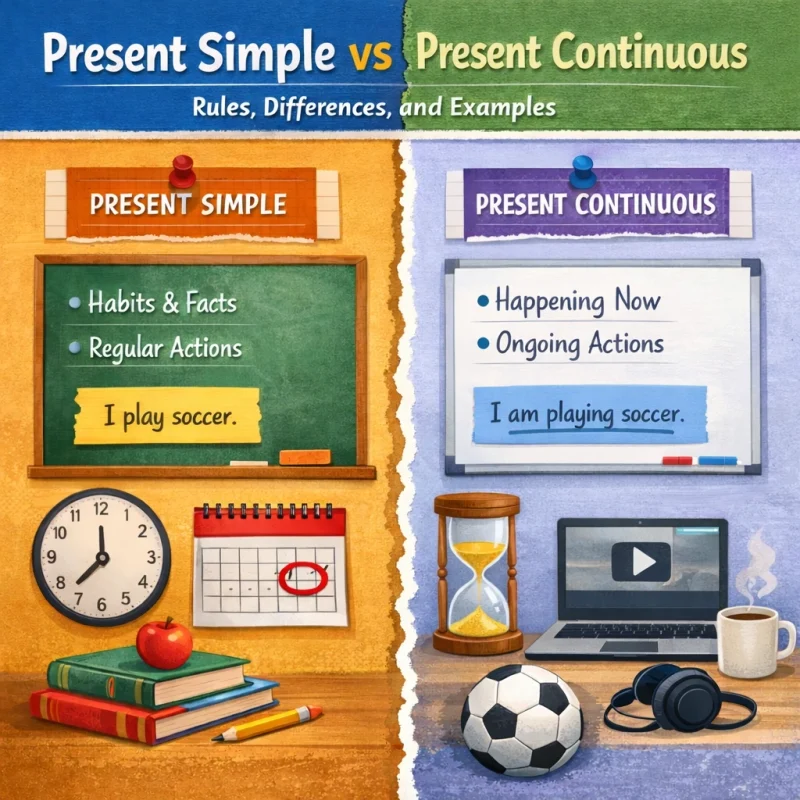
- I play football. → (present simple)
- I am playing football now. → (present continuous)
- They live in Paris. → (present simple)
- They are living in Paris this month. → (present continuous)
- He reads books. → (present simple)
- He is reading a book now. → (present continuous)
Important Notes
- In present simple, we sometimes add -s with he, she, it
→ She works, He plays - In present continuous, we always use:
am / is / are + verb + ing
Now let’s move to the most important part:
a set of present simple vs present continuous examples to compare both tenses side by side.
Present Simple vs Present Continuous Examples
The best way to understand the difference between these two tenses is to compare them side by side. These present simple vs present continuous examples show how the meaning changes depending on the tense.
Daily Routine vs Action Now
- I work every day. → (routine)
- I am working now. → (happening now)
- She drinks coffee every morning. → (habit)
- She is drinking coffee now. → (at the moment)
Permanent vs Temporary
- They live in London. → (permanent situation)
- They are living in London this month. → (temporary)
- He works in a bank. → (permanent job)
- He is working in a café this week. → (temporary)
Repeated Action vs Current Action
- We watch TV every evening. → (repeated)
- We are watching TV now. → (now)
- She reads books. → (habit)
- She is reading a book now. → (current action)
General Truth vs Changing Situation
- The sun rises in the east. → (fact)
- The climate is changing quickly. → (trend)
- Water boils at 100°C. → (fact)
- The temperature is increasing today. → (change)
Important Idea
These examples show a clear rule:
- Present simple → routines, habits, facts
- Present continuous → actions happening now or temporarily
Next, let’s look at signal words (keywords) that help you quickly choose the correct tense.
Signal Words (Keywords)
Signal words are keywords that help you decide whether to use present simple or present continuous. Recognizing them makes it easier to choose the correct tense when speaking or writing.
Present Simple Signal Words
These words indicate regular, repeated, or permanent actions:
- always
- usually
- often
- sometimes
- every day / week / month / year
- on Mondays / Fridays
- never
Examples:
- I always wake up at 7 a.m.
- She usually drinks tea in the morning.
Present Continuous Signal Words
These words indicate actions happening now, temporary situations, or trends:
- now
- at the moment
- currently
- today / this week / this month
- Look! / Listen!
- these days / nowadays
Examples:
- I am studying English now.
- She is working at the café this week.
If you want to practice tense choices with exercises, check Interactive Present Simple Exercises for Daily English, where you will find structured activities with answers.
Next, we can cover common mistakes learners make when confusing present simple and present continuous.
Common Mistakes: Present Simple vs Present Continuous
Many learners confuse present simple and present continuous, which can change the meaning of a sentence. Knowing these common mistakes helps you avoid errors.
1. Using Present Continuous for Habits
❌ I am going to school every day.
✔ I go to school every day.
Rule: Use present simple for habits and repeated actions.
2. Using Present Simple for Actions Happening Now
❌ She reads a book now.
✔ She is reading a book now.
Rule: Use present continuous for actions happening at the moment of speaking.
3. Forgetting the Auxiliary “am/is/are”
❌ He working at the office now.
✔ He is working at the office now.
Rule: Always use am, is, or are with present continuous.
4. Adding -s Incorrectly in Present Continuous
❌ She is reads a book now.
✔ She is reading a book now.
Rule: In present continuous, the main verb never takes -s; it always becomes verb+ing.
Mastering present simple vs present continuous allows you to communicate clearly and accurately in English. Remember:
- Use present simple for routines, habits, permanent facts.
- Use present continuous for actions happening now, temporary situations, and trends.
- Pay attention to signal words like always, usually (present simple) and now, at the moment (present continuous).
Fo a complete overview of all English tenses, see All tenses in English: A Simple Guide.
By understanding the differences and practicing regularly, you will confidently use both tenses in your daily English communication.