
Mastering the Present Simple tense is the first step to speaking and writing English confidently. The simple present tense helps you talk about habits, routines, facts, and general truths with ease.
In this guide, you’ll learn the Simple present tense formula, follow the simple present tense rules, and explore plenty of simple present tense examples. Plus, you’ll get practical Present Simple exercises, see how to form Present Simple questions, and understand the difference between present simple vs present continuous.
By the end, you’ll be ready to use the Present Simple tense correctly in any situation.
What Is the Present Simple Tense?
The present simple tense (also called simple present tense) is one of the most important tenses in English. It is used to talk about daily routines, habits, general facts, and repeated actions.
This tense is very common in everyday English, so learning it well will help you speak and write more clearly and confidently.
When Do We Use the Present Simple?
We use the present simple tense in these situations:
- Daily routines
→ I wake up at 7 a.m. - Habits
→ She drinks coffee every morning. - General facts
→ The sun rises in the east. - Repeated actions
→ They play football every weekend.
Simple Examples
- I work every day.
- She lives in London.
- They study English.
If you want to see more real-life examples, you can read Simple Present Tense Examples for Everyday English, which includes many practical sentences.
Why Is It Important?
The present simple tense is the foundation of English grammar. You need it to:
- talk about your daily life
- ask and answer questions
- understand basic conversations
To fully understand how it works with other tenses, you can also check All tenses in English: A Simple Guide.
Simple Present Tense Formula
To use the present simple tense correctly, you need to understand its basic formula. The structure is simple and easy to remember.
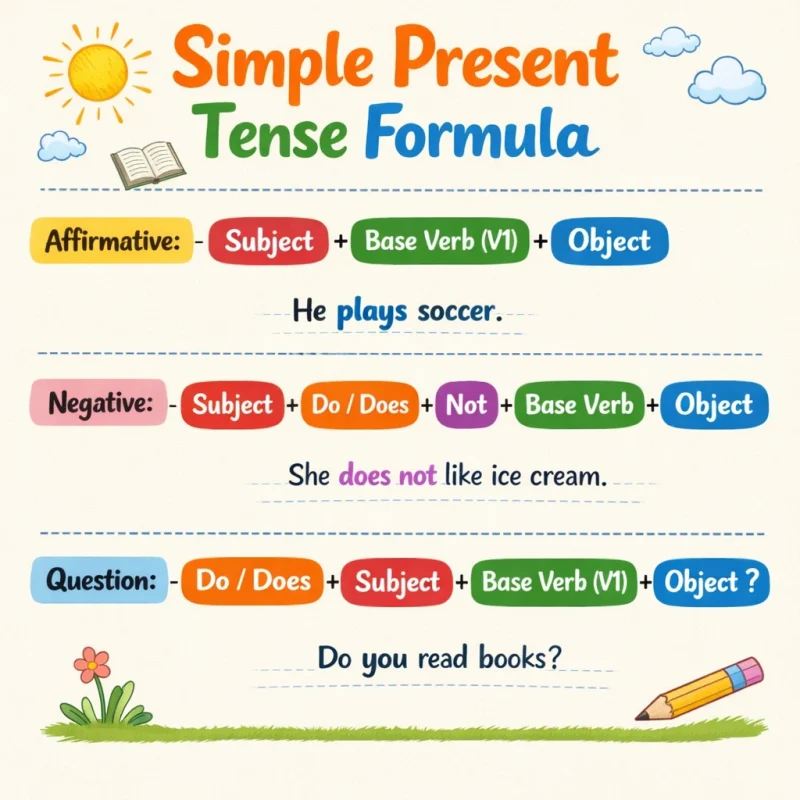
1. Affirmative Sentences (Positive)
Subject + base verb (+ s/es for he, she, it)
Examples
- I work every day.
- You play football.
- They live in Paris.
- He works every day.
- She plays tennis.
- It runs fast.
2. Negative Sentences
Subject + do/does + not + base verb
Examples
- I do not (don’t) work on Sunday.
- You do not (don’t) like coffee.
- They do not (don’t) study at night.
- He does not (doesn’t) work on Sunday.
- She does not (doesn’t) like tea.
- It does not (doesn’t) work properly.
3. Interrogative Sentences (Questions)
Do/Does + subject + base verb + ?
Examples
- Do you work every day?
- Do they play football?
- Does he work here?
- Does she like coffee?
- Does it run fast?
Important Rule
After do or does, always use the base form of the verb:
✔ Does she like coffee
✘ Does she likes coffee
If you want to practice these structures, you can try Present Simple Questions – Exercises with Answers, where you will find exercises with clear answers.
Simple Present Tense Rules
To use the present simple tense correctly, you need to follow a few important rules. These simple present tense rules will help you avoid common mistakes and build correct sentences.
1. Use the Base Form of the Verb
In most cases, we use the base form of the verb:
- I work every day.
- They play football.
- We live in a big city.
2. Add -s / -es with He, She, It
When the subject is he, she, or it, we add -s or -es to the verb:
- He works every day.
- She plays tennis.
- It runs fast.
Spelling Rules
- Add -es for verbs ending in -o, -sh, -ch, -x, -ss
→ go → goes, watch → watches - Change -y → -ies (if before it is a consonant)
→ study → studies
3. Use Do / Does in Questions
- Use do with: I, you, we, they
- Use does with: he, she, it
Examples:
- Do you like coffee?
- Does she work here?
If you want a full guide with examples, check Present Simple Questions.
4. Use Don’t / Doesn’t in Negatives
- I/You/We/They → don’t
- He/She/It → doesn’t
Examples:
- I don’t like coffee.
- She doesn’t work on Sunday.
5. Use It for Habits, Facts, and Routines
The present simple tense is used for:
- habits → I exercise every day.
- routines → She goes to work at 8 a.m.
- facts → Water boils at 100°C.
Important Tip
- Never add -s after does
❌ Does he works?
✔ Does he work?
Simple Present Tense Examples
To fully understand the present simple tense, you need to see many real examples. These simple present tense examples show how we use this tense in everyday English.
1. Daily Routines
- I wake up at 7 a.m.
- She goes to work at 8 a.m.
- They eat breakfast every morning.
- We study English every day.
2. Habits
- I drink coffee every morning.
- He plays football on weekends.
- She reads books before bed.
- They watch TV every evening.
3. General Facts
- The sun rises in the east.
- Water boils at 100°C.
- Birds fly in the sky.
- The Earth moves around the sun.
4. Negative Sentences Examples
- I don’t like coffee.
- She doesn’t work on Sunday.
- They don’t live here.
- He doesn’t eat meat.
5. Question Examples
- Do you like tea?
- Do they play football?
- Does she work here?
- Does he live in London?
Key Observation
- Use base verb with I, you, we, they
- Add -s with he, she, it
- Use do/does for questions and negatives
If you want a larger collection of organized examples, check Simple Present Tense Negative Sentences Examples, where you will find categorized sentences for better understanding.
Present Simple Questions
Forming questions in the present simple tense is easy when you follow a clear structure. These present simple questions are used to ask about daily routines, habits, and general facts.
1. Yes/No Questions
Use:
Do / Does + subject + base verb + ?
Examples
- Do you like coffee?
- Do they play football?
- Does he work here?
- Does she live in London?
2. Wh- Questions
Use:
Wh-word + do/does + subject + base verb + ?
Examples
- Where do you live?
- What do they eat?
- When does she start work?
- Why does he learn English?
3. Short Answers
- Do you like coffee? → Yes, I do. / No, I don’t.
- Does she work here? → Yes, she does. / No, she doesn’t.
Important Rule
After do or does, always use the base verb:
✔ Does she like coffee
✘ Does she likes coffee
If you want a complete explanation with more structures and examples, you can read Simple Present Tense interrogative sentences Examples.
Present Simple Exercises
Now it’s time to practice the present simple tense. These present simple exercises will help you improve your understanding of affirmative, negative, and question forms.
Exercise 1 – Choose the Correct Form
Choose the correct verb form:
- She (work / works) every day.
- They (play / plays) football on weekends.
- He (go / goes) to school at 8 a.m.
- We (watch / watches) TV every evening.
- I (like / likes) coffee.
Answers
- She works every day.
- They play football on weekends.
- He goes to school at 8 a.m.
- We watch TV every evening.
- I like coffee.
Exercise 2 – Make Negative Sentences
Rewrite using don’t / doesn’t:
- She works on Sunday.
- He likes tea.
- They live here.
- I drink coffee.
- She plays tennis.
Answers
- She doesn’t work on Sunday.
- He doesn’t like tea.
- They don’t live here.
- I don’t drink coffee.
- She doesn’t play tennis.
Exercise 3 – Make Questions
Rewrite as questions:
- You like coffee.
- She works here.
- They play football.
- He lives in London.
- You study English.
Answers
- Do you like coffee?
- Does she work here?
- Do they play football?
- Does he live in London?
- Do you study English?
Tip
Practice is the best way to master the present simple tense.
For more interactive activities, you can try Present Simple Exercises with Answers for Beginners or Present Simple Exercises for Kids for simpler practice.
Present Simple vs Present Continuous
Understanding the difference between present simple vs present continuous is essential for using English correctly.
Main Difference
- Present Simple → routines, habits, facts
- Present Continuous → actions happening now or temporary situations
Examples
- I work every day. → (routine)
- I am working now. → (happening now)
- She lives in London. → (permanent)
- She is living in London this month. → (temporary)
- They play football on weekends. → (habit)
- They are playing football now. → (current action)
Signal Words
Present Simple:
- always, usually, often
- every day, on Mondays
Present Continuous:
- now, at the moment
- today, this week
Important Rule
- Present simple → base verb (+s)
- Present continuous → am/is/are + verb+ing
Common Mistake
❌ I am knowing him
✔ I know him
If you want a full explanation with more rules and examples, you can read Present Simple vs Present Continuous: Rules & Examples.
Common Mistakes in Present Simple
Even though the present simple tense is easy, many learners make common mistakes. Understanding these errors will help you use the tense correctly.
1. Forgetting -s with He, She, It
❌ She work every day.
✔ She works every day.
❌ He play football.
✔ He plays football.
2. Adding -s After Does
❌ Does she likes coffee?
✔ Does she like coffee?
Rule: After does, always use the base verb.
3. Using Present Continuous Instead of Present Simple
❌ I am going to school every day.
✔ I go to school every day.
Rule: Use present simple for routines and habits.
4. Incorrect Negative Form
❌ She don’t like coffee.
✔ She doesn’t like coffee.
❌ He don’t work here.
✔ He doesn’t work here.
5. Using Continuous with Stative Verbs
❌ I am knowing him.
✔ I know him.
❌ She is liking chocolate.
✔ She likes chocolate.
Quick Tip
Most mistakes happen when learners:
- forget -s
- misuse do/does
- confuse simple vs continuous
Quick Summary of Present Simple
Here is a quick and easy summary of the present simple tense to help you remember the most important points:
Key Uses
- Daily routines → I wake up at 7 a.m.
- Habits → She drinks coffee every morning.
- General facts → The sun rises in the east.
Basic Structure
- Affirmative:
→ Subject + base verb (+ -s with he/she/it) - Negative:
→ Subject + do/does not + base verb - Question:
→ Do/Does + subject + base verb?
Important Rules
- Add -s / -es with he, she, it
- Use do / does for questions and negatives
- Always use the base verb after do/does
Common Signal Words
- always, usually, often
- every day, every week
- on Mondays
Final Tip
The present simple tense is the foundation of English grammar.
Practice it regularly using examples, questions, and exercises to improve your accuracy and confidence.
In conclusion, the Present Simple tense is one of the most essential tenses in English, used to describe habits, general truths, routines, and facts. Understanding its simple present tense rules and simple present tense formula makes it easier to form correct sentences in daily communication.
By practicing simple present tense examples, answering Present Simple exercises, and creating Present Simple questions, you can confidently master this tense. Remember the difference between present simple vs present continuous to avoid common mistakes.
Keep practicing regularly, and soon the Present Simple tense will become second nature in your English usage.