
Learning English for Shopping is the key to feeling confident in stores, markets, and online. From essential shopping vocabulary to practical shopping phrases and real shopping dialogues, this guide covers everything you need to communicate naturally.
You’ll discover simple sentences and complete conversations that make everyday shopping easier and more enjoyable. Start practicing now and speak English with confidence while shopping.
Shopping Vocabulary You Need for Everyday Shopping
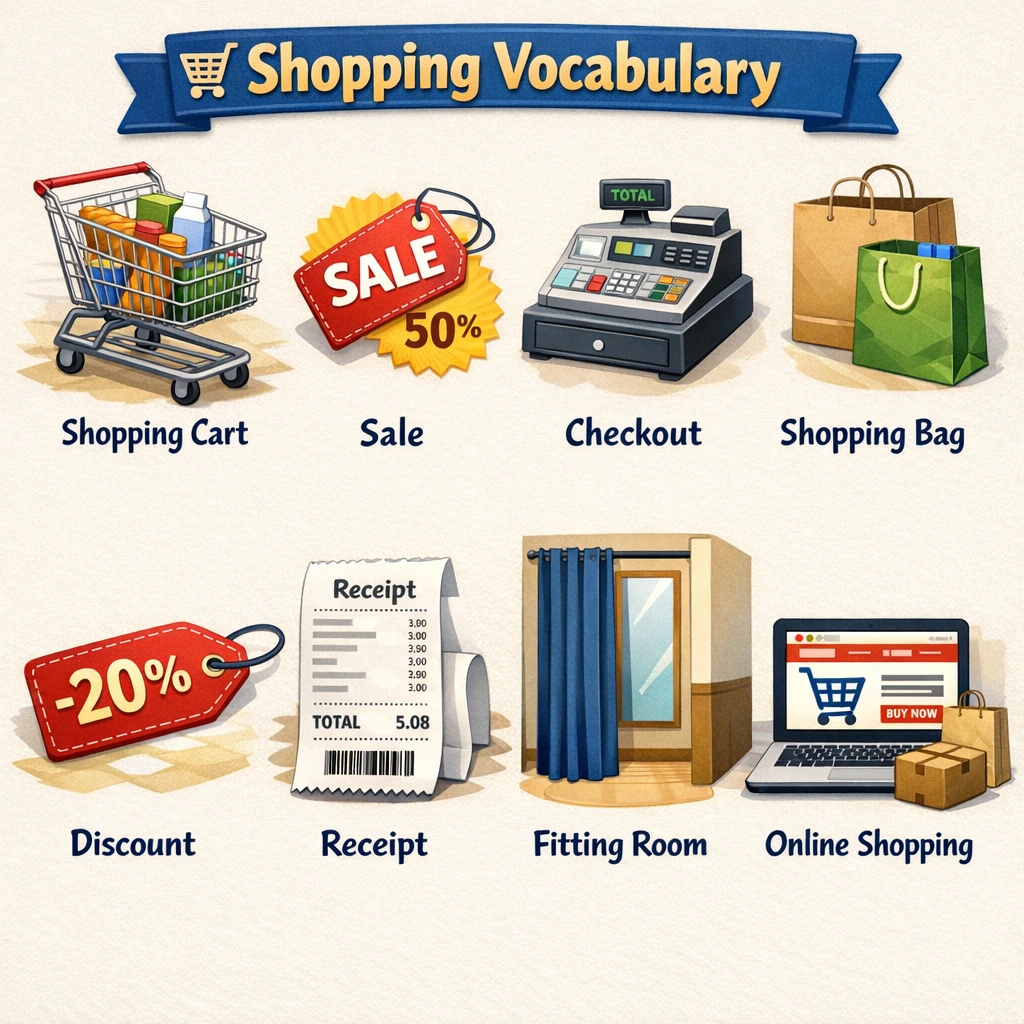
Learning basic shopping vocabulary is the first step to feeling confident when shopping in English. These common shopping words are used in stores, markets, and online shopping situations. Each word below includes a clear meaning and a simple example to help you understand and remember it easily.
- Price
Meaning: The amount of money something costs.
Example: The price of this item is reasonable. - Discount
Meaning: A reduction in the original price.
Example: There is a discount on all items today. - Cashier
Meaning: The person who takes payment in a store.
Example: Please pay the cashier at the counter. - Receipt
Meaning: A paper showing proof of payment.
Example: Keep the receipt in case you return the item. - Bag
Meaning: A container used to carry purchases.
Example: Can I have a bag, please? - Sale
Meaning: A period when items are sold at lower prices.
Example: The store is having a big sale this week. - Checkout
Meaning: The place where you pay for items.
Example: The checkout is near the entrance. - Change
Meaning: Money returned when you pay more than the price.
Example: Here is your change. - Offer
Meaning: A special deal or promotion.
Example: This offer is available today only. - Product
Meaning: An item that is for sale.
Example: This product is very popular.
For a more complete list of essential shopping terms, check out 50 Shopping Vocabulary Words You Must Know in English, which will help you understand every product, price, and sign in the store.
Shopping Phrases for Common Shopping Situations
Shopping phrases help you communicate quickly and politely in everyday shopping situations. These short and practical expressions are used when asking questions, making decisions, and interacting with store staff.
- “How much is this?”
Meaning: Asking for the price of an item.
Example: How much is this jacket? - “Do you have this in another color?”
Meaning: Asking about different color options.
Example: Do you have this in another color? - “Can I try this on?”
Meaning: Asking permission to test an item.
Example: Can I try this on, please? - “I’m just looking.”
Meaning: Saying you are browsing and not ready to buy.
Example: I’m just looking, thank you. - “Is there a discount?”
Meaning: Asking if the price is reduced.
Example: Is there a discount on this item? - “I’ll take it.”
Meaning: Saying you want to buy the item.
Example: I’ll take it. - “Can I pay by card?”
Meaning: Asking about the payment method.
Example: Can I pay by card?
These shopping phrases are essential for smooth and confident communication. In the next section, you’ll learn how to build full shopping sentences for real-life use.
Shopping Sentences for Real-Life Use
Using complete shopping sentences helps you sound more natural and confident when communicating in English. These sentences are commonly used in real shopping situations and allow you to explain needs, ask for help, and respond politely.
- “I’m looking for something affordable.”
Meaning: Saying you want a product at a reasonable price.
Example: I’m looking for something affordable for everyday use. - “This is exactly what I need.”
Meaning: Saying the product matches your needs.
Example: This is exactly what I need. - “That’s too expensive for me.”
Meaning: Saying the price is higher than you want to pay.
Example: That’s too expensive for me. - “Do you have this in stock?”
Meaning: Asking if the item is available now.
Example: Do you have this in stock today? - “I’d like to compare prices.”
Meaning: Saying you want to check prices before buying.
Example: I’d like to compare prices before deciding. - “I’ll think about it.”
Meaning: Saying you are not ready to decide.
Example: I’ll think about it and come back later. - “Can you recommend something?”
Meaning: Asking for advice from the seller.
Example: Can you recommend something similar?
These shopping sentences help you express yourself clearly in different situations. Next, we’ll move into shopping dialogues to see how full conversations work in real stores.
If you want to learn more practical phrases for daily shopping, explore Essential Shopping Phrases for Everyday English Use to communicate smoothly in any store or market.
Shopping Dialogue for Buying Products in Stores
Shopping dialogues show you how real conversations happen inside stores. These examples help you understand shopping conversation in English step by step, from asking about a product to deciding to buy it.
Dialogue 1: Buying a Product
Customer: Excuse me, I’m looking for this item.
Shop Assistant: Yes, we have it here.
Customer: How much is it?
Shop Assistant: It’s twenty dollars.
Customer: That’s fine. I’ll take it.
Dialogue 2: Asking for Details
Customer: Can you tell me more about this product?
Shop Assistant: Of course. It’s very popular and easy to use.
Customer: Sounds good.
Shop Assistant: Would you like to buy it?
Customer: Yes, please.
Dialogue 3: Confirming the Purchase
Customer: Is this the last one available?
Shop Assistant: Yes, this is the last one.
Customer: Then I’ll buy it.
Shop Assistant: Great choice. Please go to the checkout.
These shopping dialogues help you feel comfortable speaking English while shopping in physical stores. In the next section, you’ll learn how to talk about prices and payment in more detail.
Shopping Conversation in English for Prices and Payment
Talking about prices and payment is a common part of any shopping experience. These examples show how shopping conversation in English sounds when discussing costs, payment methods, and completing a purchase.
Dialogue 1: Asking About the Price
Customer: How much does this cost?
Shop Assistant: It costs thirty dollars.
Customer: Is the price final?
Shop Assistant: Yes, that’s the final price.
Dialogue 2: Talking About Payment
Customer: Can I pay by card?
Cashier: Yes, cards are accepted.
Customer: Great.
Cashier: Please enter your PIN here.
Dialogue 3: Completing the Payment
Cashier: Would you like a receipt?
Customer: Yes, please.
Cashier: Here you go.
Customer: Thank you.
Cashier: You’re welcome.
These shopping conversations help you handle prices and payment confidently. In the next section, you’ll learn shopping dialogues for clothes and fitting, which are very useful in clothing stores.
Shopping Dialogues for Clothes and Fitting
When shopping for clothes, you often need to ask about sizes, fitting rooms, and comfort. These shopping dialogues reflect common situations in clothing stores and help you communicate clearly and politely.
Dialogue 1: Asking About Size
Customer: Do you have this in a larger size?
Shop Assistant: Yes, we do.
Customer: Can I try it on?
Shop Assistant: Of course, the fitting room is over there.
Dialogue 2: Trying Clothes
Customer: This feels a bit tight.
Shop Assistant: Would you like to try a bigger size?
Customer: Yes, please.
Shop Assistant: I’ll bring it for you.
Dialogue 3: Deciding to Buy
Customer: This fits well.
Shop Assistant: It looks great on you.
Customer: I’ll take it.
Shop Assistant: Perfect. Please proceed to the checkout.
These shopping dialogues for clothes help you speak naturally when trying and choosing items. Next, we’ll look at online shopping conversations in English, which are increasingly common today.
Online Shopping Conversation in English
Online shopping also requires clear and polite communication, especially when talking about orders, delivery, or problems. These examples show how a shopping conversation in English works in online shopping situations.
Dialogue 1: Asking About Delivery
Customer: How long does delivery take?
Support Agent: It usually takes three to five days.
Customer: That’s fine for me.
Support Agent: Your order will be shipped today.
Dialogue 2: Placing an Order
Customer: I’d like to place an order online.
Support Agent: Sure. Have you added the item to your cart?
Customer: Yes, I have.
Support Agent: Please proceed to checkout.
Dialogue 3: Order Issue
Customer: My order hasn’t arrived yet.
Support Agent: Let me check the status for you.
Customer: Thank you.
Support Agent: We’ll contact you shortly with an update.
These online shopping conversations help you communicate smoothly when buying products on the internet. In the next section, you’ll see full shopping dialogues that combine everything you’ve learned so far into complete conversations.
Shopping Dialogues Examples (Full Conversations)
Full shopping dialogues help you see how vocabulary, phrases, and sentences work together in real situations. These examples show a complete shopping conversation in English from start to finish, just like what happens in real stores.
Dialogue 1: From Asking to Buying
Customer: Excuse me, I’m looking for a gift.
Shop Assistant: What kind of gift are you looking for?
Customer: Something simple and affordable.
Shop Assistant: This item is very popular.
Customer: How much is it?
Shop Assistant: It’s twenty dollars.
Customer: That sounds good. I’ll take it.
Shop Assistant: Please pay at the checkout.
Dialogue 2: Comparing and Deciding
Customer: Do you have this in another option?
Shop Assistant: Yes, we have a few alternatives.
Customer: Which one do you recommend?
Shop Assistant: This one has better quality.
Customer: Okay, I’ll choose this one.
Shop Assistant: Great choice.
Dialogue 3: Simple Everyday Shopping Conversation
Customer: How much are these items?
Cashier: They are fifteen dollars in total.
Customer: Can I pay by card?
Cashier: Yes, of course.
Customer: Here you go.
Cashier: Thank you. Have a nice day.
These complete shopping dialogues show how natural English conversations flow while shopping. In the final section, you’ll practice English for Shopping with short exercises to reinforce everything you’ve learned.
To see more complete conversations and real-life examples, refer to Shopping Dialogues for Everyday Situations in English, which covers a variety of common shopping scenarios.
English for Shopping Practice (Exercises & Examples)
Practicing English for Shopping helps you remember vocabulary, phrases, and dialogues more effectively. These short exercises are designed to reinforce what you’ve learned and improve your confidence in real shopping conversations.
Exercise 1: Choose the Correct Sentence
Choose the best sentence for each shopping situation.
- You want to know the price of an item.
a) I’ll take it.
b) How much is this?
c) I’m just looking. - You want to pay using a card.
a) Can I try this on?
b) Is there a discount?
c) Can I pay by card? - You are not ready to buy yet.
a) I’ll think about it.
b) Here is your receipt.
c) Please go to checkout.
Answers:
1 → b
2 → c
3 → a
Exercise 2: Complete the Shopping Conversation
Fill in the missing parts with suitable shopping sentences.
Customer: Excuse me, ____________________
Shop Assistant: Yes, we have it here.
Customer: ____________________
Shop Assistant: It’s twenty dollars.
Customer: ____________________
Shop Assistant: Please pay at the checkout.
Possible Answers:
- Excuse me, I’m looking for this item.
- How much is it?
- I’ll take it.
By completing these exercises, you strengthen your ability to use shopping vocabulary, shopping phrases, and shopping dialogues naturally. Regular practice will make shopping conversations in English feel easier and more confident in real-life situations.