
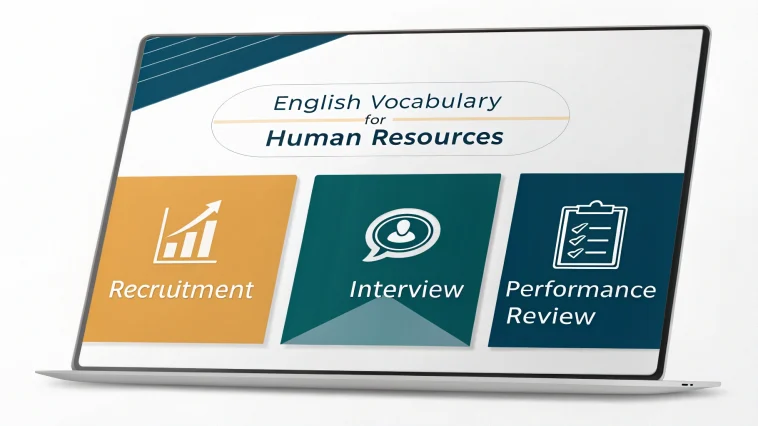
In today’s global business world, English is the primary language for communication. For HR Professionals, mastering Human Resources Terminology is not just an advantage—it is a necessity. Whether you are interviewing a candidate or writing a policy, using the right Business English for HR will help you sound professional and confident.
In this guide, we will cover the essential HR English Vocabulary you need to succeed in your career.
1. Essential Recruitment and Hiring Vocabulary
Recruitment Vocabulary is the first thing every HR specialist needs. The Hiring and Selection terms below are used daily when looking for new talent.
- Recruitment: The process of finding and hiring the best person for a job.
- Example: Our company is starting the recruitment process for a new marketing manager.
- Job Description (JD): A document that explains the tasks and responsibilities of a job.
- Example: Please read the job description carefully before applying for the position.
- Shortlist: A list of the most suitable candidates chosen from all the applicants.
- Example: We have a shortlist of five candidates for the final interview.
- Headhunting: The activity of identifying and approaching high-level professionals for a specific job.
- Example: We used a headhunting agency to find our new CEO.
2. Employment Contracts and Legal Terminology
Understanding the legal side of English for HR Professionals ensures that both the company and the employee are protected.
- Contract: A legal agreement between the employer and the employee.
- Example: You need to sign your employment contract before your first day of work.
- Termination: The end of an employee’s period of work at a company.
- Example: The termination of his contract was due to poor performance.
- Non-disclosure agreement (NDA): A contract where the employee agrees not to share the company’s private information.
- Example: All new employees must sign an NDA to protect our secrets.
- Severance pay: Money paid to an employee when their employment is ended by the company.
- Example: The company offered him three months of severance pay.
3. Performance Management and Appraisals
Effective Workplace communication vocabulary is vital during the review season. Use these Performance Review Phrases and Appraisal vocabulary English to give clear feedback.
- Appraisal: A meeting to discuss how well an employee is doing their job.
- Example: We have our annual performance appraisal next Tuesday.
- KPI (Key Performance Indicator): A clear way to measure the success of an employee or project.
- Example: One of my KPIs is to reduce the hiring time by 10%.
- Constructive feedback: Helpful advice given to someone to help them improve.
- Example: My manager gave me constructive feedback on how to lead meetings better.
- Soft skills: Personal qualities like teamwork and communication, rather than technical knowledge.
- Example: We are looking for a candidate with excellent soft skills.
4. Employee Benefits and Compensation
Discussing money and perks requires specific HR English Vocabulary to avoid misunderstandings.
- Compensation: The total money and benefits an employee receives for their work.
- Example: The company offers a very competitive compensation package.
- Perks: Extra benefits given to employees, like free gym memberships or free lunch.
- Example: Flexible working hours are one of the best perks of this job.
- Gross salary: The total amount of money an employee earns before taxes.
- Example: Her gross salary is $5,000 per month, but her take-home pay is less.
5. Common HR Idioms and Phrasal Verbs
To sound more like a native speaker, try using these common business expressions:
- To take on: To hire someone.
- Example: We are planning to take on three new interns this summer.
- To lay off: To stop employing someone because there is no more work for them.
- Example: The company had to lay off 20 workers because of the economic crisis.
- Burnout: A state of being very tired because of too much work.
- Example: HR is organizing a workshop to help employees avoid burnout.
Conclusion
Mastering English for HR Professionals is a journey. Start by using these terms in your emails and meetings, and you will quickly see a difference in your professional confidence.