
Preparing for a job interview in English can feel stressful—but the right preparation makes all the difference. This practical guide to job interview questions and answers in English gives you clear strategies, natural sentence structures, and ready-to-use examples. Follow this roadmap to speak with confidence, reduce language anxiety, and impress interviewers from the first question to the last.
Common Job Interview Questions in English (With Sample Answers)
This section covers the most common job interview questions in English that recruiters ask across different industries. Preparing clear answers in advance helps you stay calm, avoid confusion, and respond professionally during the interview.
1. Why do you want this job?
Sample Answer:
I want this job because it matches my skills and career goals. I’m especially interested in this role because it allows me to grow professionally while contributing to the company’s success.
2. What experience do you have?
Sample Answer:
I have three years of experience working in a similar position, where I developed strong communication and problem-solving skills that are relevant to this role.
3. Why should we hire you?
Sample Answer:
You should hire me because I am reliable, motivated, and able to learn quickly. I always focus on delivering high-quality results and working well with a team.
4. What do you know about our company?
Sample Answer:
I know that your company values innovation and customer satisfaction. I admire your recent projects and your strong reputation in the industry.
5. Are you comfortable working under pressure?
Sample Answer:
Yes, I am. I stay organized and prioritize tasks carefully, which helps me remain focused and productive even in stressful situations.
These interview answers in English are short, clear, and easy to adapt. You don’t need advanced vocabulary—clarity and relevance matter most.
To strengthen your answers with advanced vocabulary and clear sentence structures, see How to Build Strong Answers with English for Job Interview.
Tell Me About Yourself: Best English Answers for Job Interviews
“Tell me about yourself” is often the first and most important question in a job interview. A strong answer sets the tone and shows confidence from the beginning. The key is to stay professional and structured, not personal.
A simple and effective structure is:
Present role → Past experience → Future goal
Sample Answer 1 (General):
I’m a motivated professional with a background in customer service. I’ve worked in this field for over two years, where I improved my communication skills and learned how to handle different client needs. I’m now looking for an opportunity to grow and add value to a dynamic team.
Sample Answer 2 (Entry-Level):
I recently graduated with a degree in business administration. During my studies, I completed internships that helped me develop teamwork and organizational skills. I’m eager to start my career and apply what I’ve learned in a practical environment.
Sample Answer 3 (Experienced):
I’m an experienced project coordinator with five years of experience managing schedules and teams. In my current role, I’ve successfully delivered projects on time and within budget. I’m now seeking a new challenge where I can take on more responsibility.
When answering this question, avoid long life stories. Focus on relevant experience, skills, and goals. A clear and confident introduction makes a strong first impression and prepares the interviewer for the rest of your answers.
If you want a step-by-step structure and ready-made examples, read How to Answer “Tell Me About Yourself” in a Job Interview to deliver a confident and professional introduction.
Job Interview Questions About Experience and Skills
Interviewers ask about experience and skills to understand how well your background matches the role. The goal is to connect what you’ve done in the past with what the company needs now. Keep your answers focused, relevant, and supported by examples.
1. What experience do you have for this role?
Sample Answer:
I have experience working in a similar position, where I handled daily tasks related to this role. Through this experience, I developed strong communication and organizational skills that I can apply immediately.
2. What skills make you a good fit for this job?
Sample Answer:
I believe my problem-solving and teamwork skills make me a strong fit. I’m comfortable working with deadlines and adapting quickly to new responsibilities.
3. Can you describe a project you worked on?
Sample Answer:
In my previous role, I worked on a project that required close coordination with different departments. I was responsible for organizing tasks, meeting deadlines, and ensuring clear communication, which led to successful results.
4. How do you keep your skills up to date?
Sample Answer:
I regularly learn through online courses, practice, and feedback from colleagues. This helps me improve continuously and stay effective in my work.
When answering these questions, focus on relevance over quantity. One clear example explained well is more powerful than listing many experiences without detail.
Strengths and Weaknesses Interview Questions in English
Questions about strengths and weaknesses help interviewers evaluate self-awareness and honesty. The key is to stay professional and show a positive mindset, especially when talking about weaknesses.
1. What are your strengths?
Sample Answer:
One of my main strengths is my ability to stay organized and manage my time efficiently. This helps me complete tasks accurately and meet deadlines consistently.
2. What is your greatest strength at work?
Sample Answer:
My greatest strength is adaptability. I adjust quickly to new situations and remain productive even when priorities change.
3. What is your biggest weakness?
Sample Answer:
In the past, I found it challenging to delegate tasks. However, I’ve worked on improving this by trusting my team and communicating more clearly.
4. How are you improving your weaknesses?
Sample Answer:
I focus on self-improvement by asking for feedback and learning from experience. This approach has helped me turn weaknesses into areas of growth.
A strong answer shows balance: confidence when discussing strengths and responsibility when discussing weaknesses. Always highlight what you’ve learned and how you’re improving.
Behavioral Job Interview Questions in English (Using the STAR Method)
Behavioral questions focus on how you acted in real situations in the past. Interviewers believe that past behavior is the best indicator of future performance. To answer these questions clearly in English, the STAR method is the most effective structure.
STAR Method Explained:
- Situation: Describe the context briefly
- Task: Explain your responsibility
- Action: Describe what you did
- Result: Share the outcome
1. Tell me about a time you faced a challenge at work.
Sample Answer:
In my previous role, we faced a tight deadline (Situation). I was responsible for organizing the workflow (Task). I prioritized tasks and coordinated with the team daily (Action). As a result, we completed the project on time and met all requirements (Result).
2. Describe a situation where you worked in a team.
Sample Answer:
During a group project, my role was to support communication between members. I encouraged regular updates and resolved small issues early. This helped the team stay aligned and successfully achieve our goal.
Using the STAR method keeps your answers organized and professional, even if your English is simple. It helps you stay focused and confident under pressure.
Job Interview Questions About Career Goals and Motivation
Questions about career goals and motivation help interviewers understand your long-term vision and commitment. Employers look for candidates whose goals align with the company’s direction.
1. What are your career goals?
Sample Answer:
My career goal is to continue developing my skills and take on more responsibility over time. I want to grow within a company where I can contribute consistently and learn from experienced professionals.
2. Where do you see yourself in five years?
Sample Answer:
In five years, I see myself in a more advanced role, with stronger expertise and leadership responsibilities. I hope to be part of a team where I can add long-term value.
3. What motivates you at work?
Sample Answer:
I’m motivated by opportunities to learn, solve problems, and see positive results from my efforts. Achieving goals and contributing to team success drives me.
4. Why did you choose this career path?
Sample Answer:
I chose this path because it matches my strengths and interests. Over time, I’ve confirmed that this field allows me to grow professionally while doing meaningful work.
Strong answers in this section show direction, commitment, and enthusiasm. Be honest, stay realistic, and connect your goals to the role you’re applying for.
English Answers for Salary, Availability, and Work Conditions
Questions about salary, availability, and work conditions often come near the end of the interview. The key here is to sound professional, flexible, and informed—without underselling yourself.
1. What are your salary expectations?
Sample Answer:
Based on my experience and the responsibilities of this role, I’m looking for a salary that is fair and competitive. I’m open to discussion and would be happy to consider the full compensation package.
2. Are you open to negotiation?
Sample Answer:
Yes, I’m open to negotiation. My priority is finding a role that fits my skills and allows for growth, so I’m flexible depending on the overall offer.
3. When can you start?
Sample Answer:
I can start within two weeks, as I want to ensure a smooth transition from my current responsibilities.
4. Are you comfortable with our working hours or conditions?
Sample Answer:
Yes, I am. I’ve reviewed the work conditions, and they align well with my expectations and work style.
When answering these questions, stay calm, polite, and realistic. Showing flexibility while knowing your value leaves a strong professional impression.
To handle salary discussions with confidence and professionalism, explore 10 Powerful Phrases for Salary Negotiation in English and learn how to negotiate without feeling uncomfortable.
Tricky Job Interview Questions in English and How to Handle Them
Tricky interview questions are designed to test your honesty, self-awareness, and emotional control—not to confuse you. The best strategy is to stay composed and respond thoughtfully.
1. Why did you leave your last job?
Sample Answer:
I was looking for new challenges and opportunities for growth. I appreciated my previous role, but I felt it was time to take the next step in my career.
2. Have you ever failed at work?
Sample Answer:
Yes, like everyone, I’ve faced setbacks. What matters most is that I learned from the experience and improved my approach moving forward.
3. What would your manager say about you?
Sample Answer:
They would describe me as reliable, professional, and focused on delivering quality results.
4. Why is there a gap in your employment?
Sample Answer:
During that time, I focused on personal development and improving my skills, which has prepared me better for my next role.
For tricky questions, avoid being defensive. Stay positive, honest, and solution-focused. Interviewers respect candidates who can reflect on challenges and show growth.
How to Answer Job Interview Questions in English with Confidence
Answering job interview questions in English confidently is not about memorizing perfect sentences—it’s about understanding structure, intention, and clarity. Many candidates feel nervous because they translate directly from their native language or worry about making grammar mistakes. The good news is that interviewers focus more on clear communication and logical answers than on perfect English.
The first step is to understand the question type. Some questions test your experience, others your personality, and some your problem-solving skills. Take a short moment before answering to organize your thoughts. This pause shows professionalism, not weakness.
Use simple and direct sentences. Short, well-structured answers sound more confident than long, complex ones. If a question asks about your experience, focus on one relevant example instead of listing everything you have done.
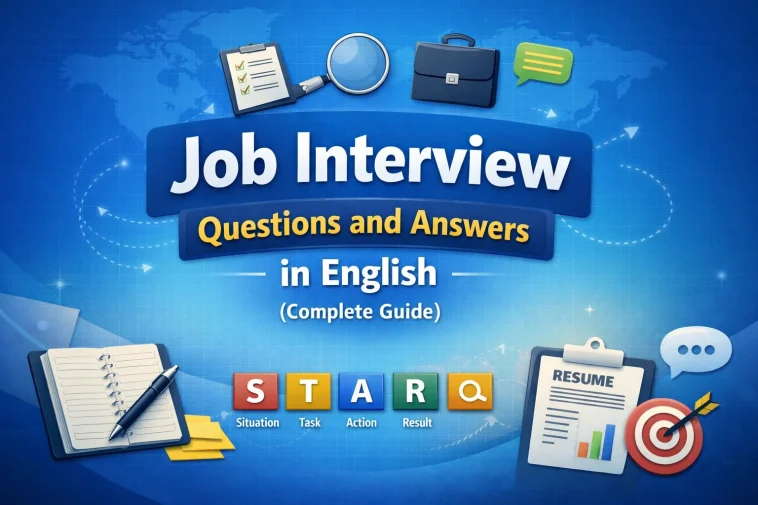
A powerful strategy is the STAR method (Situation, Task, Action, Result). It helps you give organized and professional interview answers in English:
- Situation: Brief context
- Task: Your responsibility
- Action: What you did
- Result: The outcome
For example, when asked about a challenge, this structure keeps your answer focused and easy to follow.
It’s also important to use transition phrases such as for example, in my previous role, or as a result. These expressions make your English sound natural and fluent, even if your vocabulary is simple.
Finally, confidence comes from practice, not perfection. Rehearse common job interview questions in English out loud, record yourself, and focus on clarity. When you speak calmly, structure your answers well, and stay authentic, your confidence will be clear—regardless of your accent.
Conclusion
Mastering job interview questions and answers in English is one of the most effective ways to reduce stress and perform confidently during interviews. By preparing clear answers, understanding common question types, and using proven strategies like the STAR method, you can communicate your skills, experience, and motivation in a professional and natural way. Remember, success in an interview is not about perfect English, but about clear structure, relevant examples, and confident delivery.
To strengthen your answers even more, we highly recommend reviewing Job Interview Vocabulary: 42 Essential English Words, which will help you choose the right words and expressions when responding to interview questions. Combining strong vocabulary with well-prepared answers will give you a complete roadmap to succeed in any English job interview.
After the interview, professional communication is essential. You can improve your follow-up skills by mastering business email phrases for requesting meetings and sending follow-up emails with ready-to-use templates.