


Do you want to speak English confidently while traveling?
Learning the right travel verbs makes it much easier to talk about your trips.
In this guide, you will discover the most useful verbs for travel, including actions at the airport, in hotels, and during sightseeing.
You will also find simple examples, exercises, and tips to remember these verbs related to travel.
By the end of this article, you will be ready to use travel verbs naturally on your next holiday!
What Are Travel Verbs?
Travel verbs are verbs we use when we talk about travel, trips, and holidays.
They help us explain what we do before, during, and after a trip.
Travel verbs describe actions like:
- going to a place
- arriving or leaving
- staying in a hotel
- visiting new places
For example:
- I travel to London every year.
- We arrive at the airport early.
- She books a hotel online.
These verbs are very common in daily travel situations.
Learning verbs for travelling helps you speak more clearly and confidently when you travel or go on vacation.
Common Travel Verbs You Should Know
There are many travel verbs, but some are used more often than others.
In the sections below, you will learn the most common verbs for travelling used in real situations.
We will look at travel verbs for:
- transportation
- airports and flights
- hotels and accommodation
- sightseeing and activities
These verbs about travel will help you speak more naturally during your trips.
Travel Verbs for Transportation
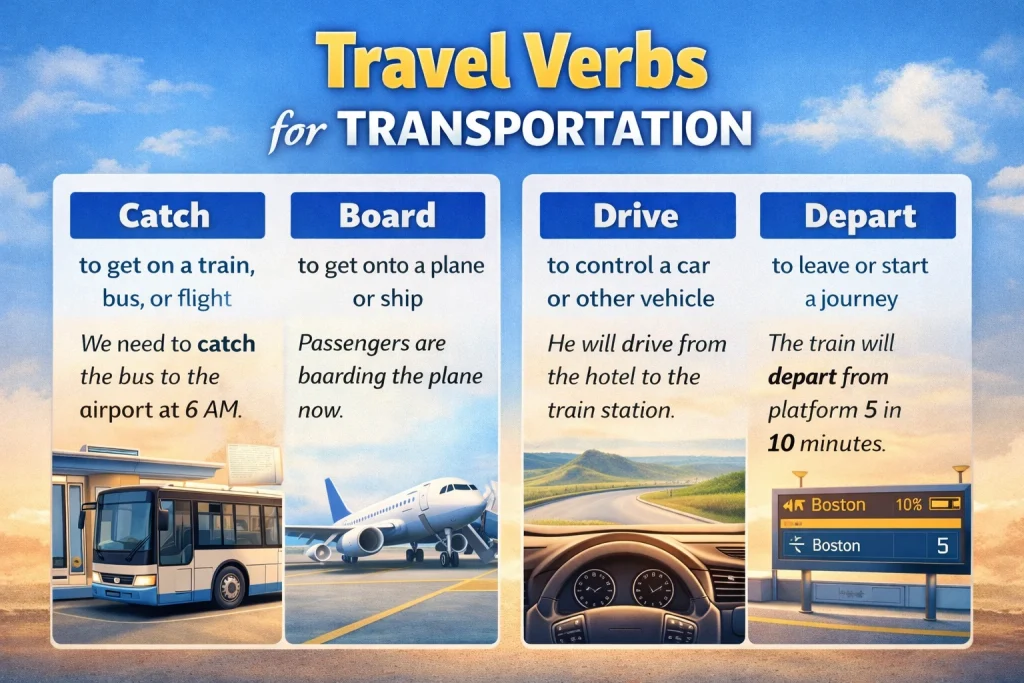
| Travel Verbs for Transportation | Meaning | Example |
|---|---|---|
| go | to move from one place to another | I go to work by bus. |
| travel | to make a journey | We travel to Spain in summer. |
| arrive | to reach a place | They arrive at the airport early. |
| leave | to go away from a place | The train leaves at 7 a.m. |
| fly | to travel by plane | She flies to Paris tomorrow. |
| drive | to travel by car | He drives to the hotel. |
| take | to use transport | We take a taxi to the station. |
| return | to go back | I return home on Sunday. |
Travel Verbs for Airports and Flights
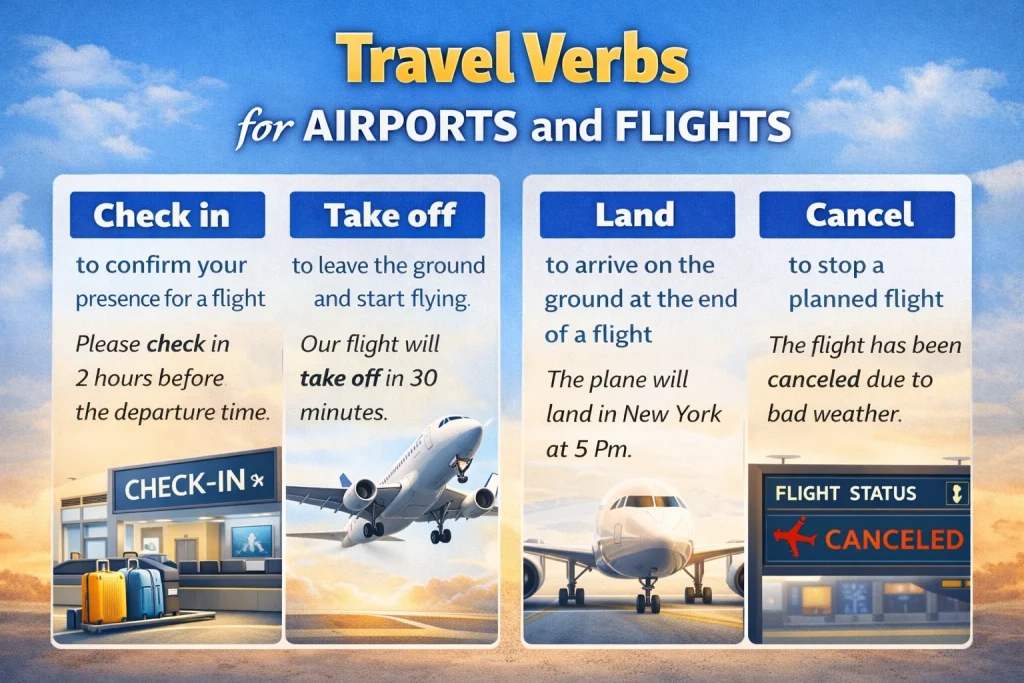
| Travel Verbs for Airports and Flights | Meaning | Example |
|---|---|---|
| check | to confirm your arrival at the airport or flight | I check my luggage at the counter. |
| board | to get on a plane | We board the plane at gate 5. |
| land | to arrive on the ground after a flight | The plane lands at 10 a.m. |
| delay | when a flight happens later than planned | Our flight is delayed by two hours. |
| cancel | to stop a flight or booking | They cancel the flight because of the storm. |
| depart | to leave (usually by plane) | The flight departs at 8 p.m. |
| take off | when a plane leaves the ground | The plane takes off on time. |
Travel Verbs for Hotels and Accommodation
| Travel Verbs for Hotels and Accommodation | Meaning | Example |
|---|---|---|
| book | to arrange a room or reservation | I book a hotel online. |
| stay | to sleep or live somewhere temporarily | We stay at a nice hotel in Rome. |
| check in | to arrive and register at a hotel | They check in at 3 p.m. |
| check out | to leave and pay at a hotel | We check out early in the morning. |
| reserve | to save a room or service in advance | She reserves a double room for two nights. |
| cancel | to stop a booking | He cancels his hotel reservation. |
| extend | to stay longer than planned | We extend our stay for one more night. |
Travel Verbs for Sightseeing and Activities
| Travel Verbs for Sightseeing and Activities | Meaning | Example |
|---|---|---|
| visit | to go to a place for sightseeing | We visit the museum every summer. |
| explore | to go around and discover places | They explore the old town on foot. |
| enjoy | to have a good time | I enjoy walking by the beach. |
| relax | to rest and feel calm | She relaxes in the hotel garden. |
| discover | to find new places or experiences | He discovers a small café in Paris. |
| take | to take photos or souvenirs | We take many photos during our trip. |
| go sightseeing | to see interesting places | They go sightseeing in London. |
If you want to learn more travel verbs and phrasal verbs for real-life situations, check out our [Essential Travel Phrasal Verbs] for clear explanations and practical exercises.
Travel Verbs Vocabulary in Simple Sentences
Learning travel verbs is very important for anyone who wants to speak English while traveling.
These verbs for travel and holidays help you describe actions you do during trips.
Using verbs related to travel in sentences makes it easier to remember them and use them in real situations.
Here are many travel verbs vocabulary examples in simple sentences:
- go – I go to the airport every morning.
- travel – We travel to Italy in the summer.
- arrive – The train arrives at 9 a.m.
- leave – She leaves the hotel at 10 a.m.
- book – I book my flight online.
- stay – We stay at a small hotel in Paris.
- check in – They check in at the front desk.
- check out – We check out of the hotel at noon.
- reserve – He reserves a table at the restaurant.
- cancel – She cancels her hotel booking.
- board – We board the plane at 5 p.m.
- land – The plane lands on time.
- depart – The flight departs at 8 a.m.
- fly – I fly to New York every year.
- drive – He drives to the airport.
- take – We take a taxi to the hotel.
- explore – They explore the old town on foot.
- visit – We visit the museum on Monday.
- discover – She discovers a new café in the city.
- enjoy – I enjoy walking by the river.
- relax – We relax in the hotel garden.
- go sightseeing – They go sightseeing in London.
- pack – I pack my bag before the trip.
- unpack – She unpacks her suitcase at the hotel.
- return – We return home after the vacation.
Common Mistakes with Travel Verbs
When learning travel verbs, beginners often make small mistakes.
Here are some common errors and how to correct them:
- Using the wrong verb tense
- ❌ I go to Paris yesterday.
- ✅ I went to Paris yesterday.
- Confusing similar verbs
- ❌ I take a hotel for two nights.
- ✅ I book a hotel for two nights.
- Forgetting the particle in phrasal verbs
- ❌ We check the hotel at 3 p.m.
- ✅ We check in at the hotel at 3 p.m.
- Mixing “arrive” and “reach”
- ❌ We reach at the airport late.
- ✅ We arrive at the airport late.
- Using “go” incorrectly with transport
- ❌ I go the bus to school.
- ✅ I go by bus to school.
Learning these small corrections helps you use travel verbs confidently in real situations.
Travel Verbs Practice Exercises
Practice is very important to remember travel verbs and use them correctly.
Try these exercises:
Exercise 1: Choose the Correct Travel Verb
Fill in the blanks with the correct verb:
- We always ____ to Italy in summer. (travel / stay)
- She ____ at the hotel at 2 p.m. (check in / leave)
- I ____ a taxi to the airport. (take / go)
- The plane ____ at 10 a.m. (lands / boards)
- He ____ his hotel room online. (books / packs)
Exercise 2: Fill in the Blanks
Complete the sentences with a travel verb from the box:
(go, arrive, explore, enjoy, check out, fly)
- I love to ____ new cities on holiday.
- We ____ at the airport two hours before the flight.
- She ____ to London every year.
- They ____ the hotel at noon.
- We always ____ the museum and parks.
Exercise 3: Match the Verb with the Meaning
Draw a line to match the travel verb with its meaning:
| Travel Verb | Meaning |
|---|---|
| pack | a. leave your luggage in a suitcase |
| check in | b. arrive at the hotel and register |
| board | c. get on a plane, bus, or train |
| relax | d. rest and feel calm |
| visit | e. go to see a place |
Doing these exercises helps you use travel verbs in real trips and speak more naturally.
How to Learn and Remember Travel Verbs Easily
Learning travel verbs is easier if you follow some simple tips:
- Group verbs by situations
- For example: airport verbs, hotel verbs, sightseeing verbs.
- Use sentences
- Make short sentences with each verb. Example: I check in at 3 p.m.
- Practice every day
- Speak, write, or read sentences with verbs for travel.
- Use pictures or flashcards
- Draw or see a picture and say a verb. Example: picture of a plane → fly.
- Repeat and review
- Repeat the verbs you learned before your next trip.
Following these tips helps you remember travel verbs and use them confidently in real travel situations.
Final Tips to Use Travel Verbs with Confidence
Using travel verbs confidently makes your trips easier and more fun. Here are some final tips:
- Speak aloud – Practice saying sentences with travel verbs. Example: I arrive at the airport early.
- Write your travel plan – Use verbs for travel to describe your itinerary.
- Use them in real situations – Try your new verbs at the hotel, airport, or when sightseeing.
- Review and expand – Check our [Ultimate Travel Vocabulary Guide] to learn even more words and phrases for every travel situation.
Learning verbs related to travel step by step helps you speak English naturally and enjoy your holidays without stress.
Conclusion
Learning travel verbs is a simple and effective way to speak English confidently while traveling.
Using these verbs for travel in sentences and real situations helps you communicate clearly at airports, hotels, and sightseeing places.
To improve your English even more, don’t forget to check our [50 Essential Travel Idioms to Speak Like a Native (2026 Guide)]. These idioms, together with the verbs related to travel you learned here, will help you sound more natural and fluent on your trips.
Keep practicing your travel verbs and idioms every day, and enjoy speaking English during your holidays!