


Do you want to speak English confidently when flying?
Learning the right verbs for flying helps you talk about airports, flights, and trips.
In this guide, you will learn the most important words for flying, including fly verb forms (V1, V2, V3), examples, and easy practice exercises.
By the end, you will be able to use verbs for flying naturally in your travels.
What Does “Fly” Mean in English?
The verb fly means to move through the air.
We often use fly when we talk about airplanes, travel, and flights.
In travel English, fly means to go from one place to another by plane.
Examples:
- I fly to London every summer.
- She flies to Dubai for work.
- We fly by plane, not by train.
The verb fly is one of the most common verbs for flying, and you will see it a lot when learning words for flying and travel English.
Common Verbs for Flying You Should Know
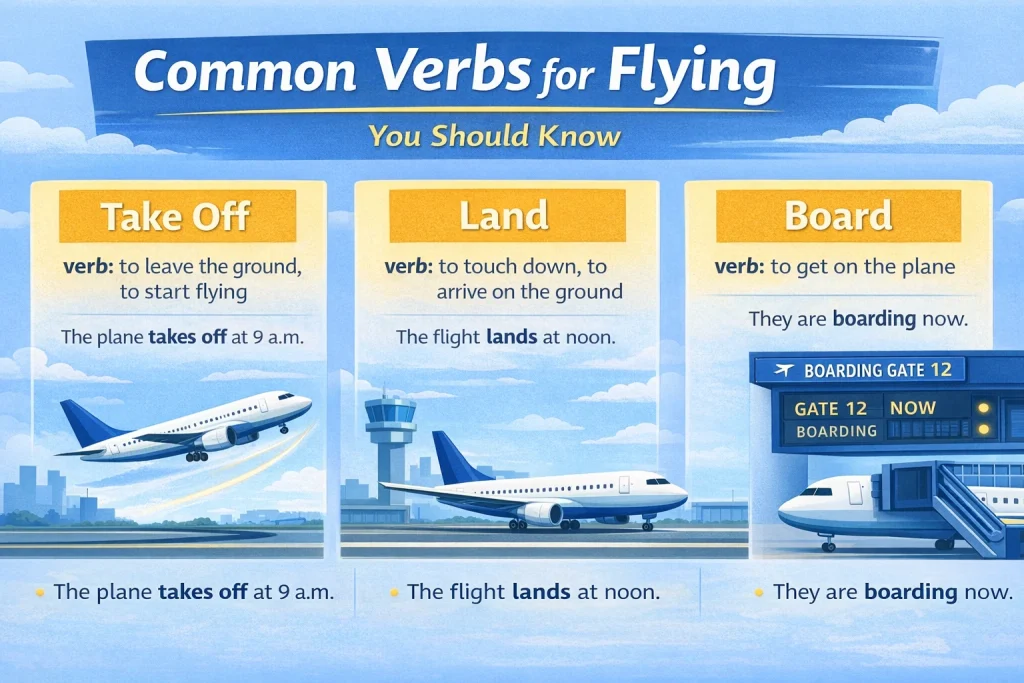
When you talk about air travel, you need more than just the verb fly.
Learning common verbs for flying helps you understand airport signs, flight announcements, and travel conversations. These words for flying are very useful before, during, and after a flight.
Below is a list of important verbs for flying, with simple meanings and examples.
| Verb | Meaning | Example |
|---|---|---|
| fly | to travel by plane | I fly to New York tomorrow. |
| take off | when a plane leaves the ground | The plane takes off at 7 a.m. |
| land | when a plane comes down to the ground | The plane lands safely. |
| board | to get on the plane | Passengers board the plane early. |
| depart | to leave a place | The flight departs at noon. |
| arrive | to reach a place | We arrive at the airport on time. |
| check in | to register for a flight | I check in online. |
| take | to use transport | We take a flight to Rome. |
| cancel | to stop a flight | The airline cancels the flight. |
| delay | to make a flight late | Bad weather delays the flight. |
| book | to reserve a flight | I book my ticket online. |
| miss | to not catch a flight | He misses his flight. |
| connect | to change planes | We connect in Dubai. |
| travel | to go from one place to another | I travel by plane. |
| return | to go back | We return home on Sunday. |
Want to learn even more travel words and phrases for airports, flights, and trips? Check out our [Ultimate Travel Vocabulary Guide] for a complete list and practice exercises.
The Verb “Fly” Forms (V1, V2, V3)
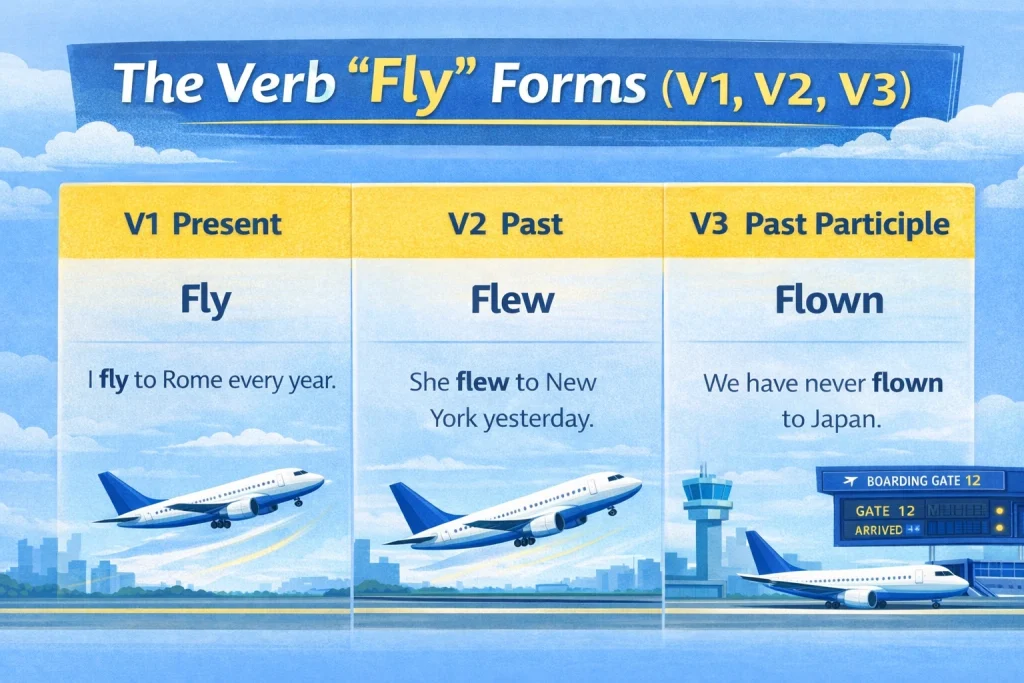
Like many common English verbs, fly has different forms.
These forms help you talk about the present, the past, and finished actions.
The verb fly is one of the most important verbs for flying, and it is also an irregular verb.
| Verb Form | Form | Example |
|---|---|---|
| V1 (Base form) | fly | I fly to Madrid every year. |
| V2 (Past simple) | flew | I flew to Madrid last year. |
| V3 (Past participle) | flown | I have flown to Madrid many times. |
- Fly (V1) is used for the present and future.
- Flew (V2) is used for the past tense.
- Flown (V3) is used with have / has / had.
These are the correct fly verb forms (V1, V2, V3), and you must remember them because fly does not follow regular rules.
Is “Fly” an Irregular Verb?
Yes, fly is an irregular verb.
This means it does not add -ed in the past.
- ❌ flyed (incorrect)
- ✅ flew (past)
- ✅ flown (past participle)
Because of this, fly is listed with other irregular verbs in English.
Examples:
- I flew to London last week.
- She has flown many times before.
When learning verbs for flying, it is important to remember that fly → flew → flown.
Verb Fly in the Past Tense
The past tense of the verb fly is flew.
We use flew to talk about a flight that happened in the past.
This form is very common when talking about trips and travel history.
Structure:
fly → flew
Examples:
- I flew to Paris last year.
- We flew with the same airline before.
- She flew to Tokyo for work.
Remember:
- Do NOT say ❌ flyed
- Always say ✅ flew
Learning the verb fly in past tense helps you talk clearly about past trips and flights.
Verb Fly in the Past Participle
The past participle of the verb fly is flown.
We use flown with have, has, or had to talk about experiences or completed actions.
This form is very important when learning verbs for flying.
Structure:
have / has / had + flown
Examples:
- I have flown to Dubai before.
- She has flown with this airline many times.
- They had flown all night.
Remember:
- ❌ have flew (incorrect)
- ✅ have flown (correct)
Using the verb fly in past participle helps you talk naturally about travel experiences.
Verbs for Flying in Simple Sentences
| Verb | Example |
|---|---|
| fly | I usually fly in the morning. |
| flew | They flew across the ocean. |
| flown | She has flown alone before. |
| take off | The plane takes off very soon. |
| land | Our flight lands late tonight. |
| board | We board the plane after lunch. |
| depart | The flight departs from gate 12. |
| arrive | The plane arrives at midnight. |
| check in | I check in with my passport. |
| book | We book our flights early. |
| cancel | The airline cancels many flights today. |
| delay | Fog delays the morning flights. |
| miss | I almost miss my flight. |
| connect | We connect through Frankfurt. |
| return | They return by plane next week. |
To see a complete list of 29 essential travel verbs with examples, check our guide [29 Travel Verbs You Must Know: Easy Guide for Every Traveler].
Common Mistakes with the Verb “Fly
When learning verbs for flying, beginners often make small mistakes.
Here are some common errors and the correct way to say them:
- Using the wrong past form
- ❌ Yesterday I fly to Paris.
- ✅ Yesterday I flew to Paris.
- Confusing past participle
- ❌ I have flew to London before.
- ✅ I have flown to London before.
- Incorrect use with take off / land
- ❌ The plane take off at 8 a.m.
- ✅ The plane takes off at 8 a.m.
- Forgetting to use check in properly
- ❌ I check in the airport.
- ✅ I check in at the airport.
- Mixing depart and leave
- ❌ The flight leaves at the airport.
- ✅ The flight departs from the airport.
Learning these small corrections helps you use verbs for flying confidently in real travel situations.
For more advanced English, explore our [Essential Travel Phrasal Verbs] to learn useful phrasal verbs for airports, flights, and trips.
Practice Exercises: Verbs for Flying – With Answers
Exercise 1: Fill in the Blank
Use the correct verb from the box:
(fly, flew, flown, take off, land, board, depart, arrive, check in)
- I ____ to Rome yesterday.
Answer: I flew to Rome yesterday. - The plane will ____ at 9 a.m.
Answer: The plane will take off at 9 a.m. - We have never ____ to Japan before.
Answer: We have never flown to Japan before. - Passengers ____ at gate 5.
Answer: Passengers board at gate 5. - The flight ____ at noon.
Answer: The flight departs at noon.
Exercise 2: Choose the Correct Verb
Circle the correct verb:
- She (fly / flew / flown) to New York last week.
Answer: She (flew) to New York last week. - We (take off / land) from Paris now.
Answer: We (take off) from Paris now. - I have (flew / flown) many times to London.
Answer: I have (flown) many times to London. - He (check in / boards) online today.
Answer: He (check in) online today. - The plane (depart / arrives) at 6 p.m.
Answer: The plane (arrives) at 6 p.m.
Final Tips to Use Verbs for Flying Confidently
Learning verbs for flying helps you speak English confidently during your trips. Here are some final tips:
- Practice every day – Say simple sentences with the verbs aloud.
- Use different tenses – Try fly, flew, flown in past, present, and perfect sentences.
- Combine with other travel verbs – Use them with check in, take off, land, board in real situations.
- Read and review – Check our [50 Essential Travel Idioms ] to learn fun expressions and idioms for traveling.
Keep practicing these verbs for flying and idioms, and you will speak English naturally at airports, on flights, and during your trips.